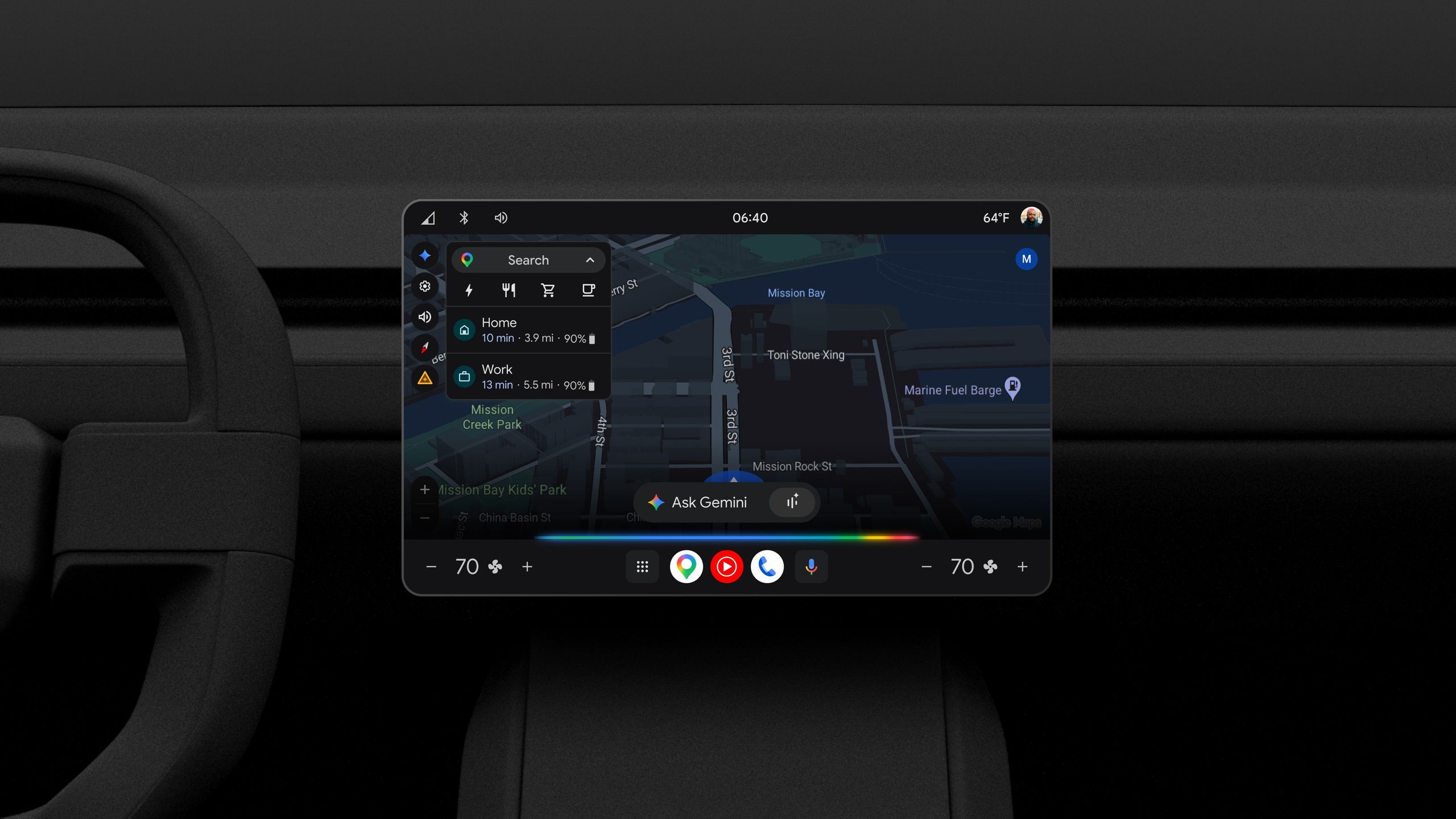
Google is rolling out a free over-the-air upgrade that replaces Google Assistant with Gemini in cars with Google built-in, starting in English in the U.S. The update adds natural-language navigation, contextual follow-ups, message editing, and vehicle-specific troubleshooting, with deeper integrations into Gmail, Calendar, and Google Home coming soon. The announcement is positive for Google’s in-car AI strategy and automaker software differentiation, but the near-term market impact should be limited.
This is a modest but important reinforcement of Google’s platform strategy: the value is not the voice UI itself, but the incremental retention layer it adds to Search/Maps/YouTube/Workspace across a higher-frequency, high-intent environment. Cars are one of the few places where conversational AI can convert into habitual usage without the user choosing to open an app, which should improve engagement data quality and reinforce Google’s lead in location-aware intent. The second-order effect is less about immediate monetization and more about deepening switching costs for automakers that have adopted Google built-in, which makes Android Automotive a more durable distribution wedge versus fragmented OEM software stacks.
The main competitive loser is Apple’s in-car ecosystem strategy, which remains more dependent on CarPlay integration than native dashboard control. For OEMs, this is a subtle but real loss of interface ownership: the more the assistant becomes the default layer for navigation, messaging, and vehicle troubleshooting, the more the automaker risks becoming a commodity hardware provider. That said, the feature is also a proof point for OEMs using Google built-in to reduce software development costs, so adoption should be bifurcated: premium brands with stronger in-house UX ambitions may resist, while volume OEMs are likely to lean further in.
The near-term market reaction is probably capped because this is an ecosystem upgrade, not a direct revenue catalyst, and commercialization of in-car AI will likely lag by 12-24 months. The bigger risk is product reliability: if response quality is inconsistent, usage will be superficial and churn to legacy controls will be high, especially in safety-sensitive settings. A second risk is regulatory scrutiny once the assistant begins touching Gmail/Calendar/Home in a driving context, which could slow rollout in Europe and extend the timeline before this becomes a meaningful monetization lever.
The contrarian angle is that this may be more durable than the market assumes because cars create a rare, repeated use case where AI utility is obvious and willingness to tolerate conversational friction is higher than on a phone. If Google can make the assistant genuinely useful for navigation plus EV charging workflows, it strengthens the Android/Maps moat even if direct ARPU is minimal. The investment implication is that this is a slow-burn platform win for Google rather than a headline-driven trade, but it could pressure smaller infotainment/software vendors over time.
AI-powered research, real-time alerts, and portfolio analytics for institutional investors.
Request DemoOverall Sentiment
mildly positive
Sentiment Score
0.35
Ticker Sentiment
