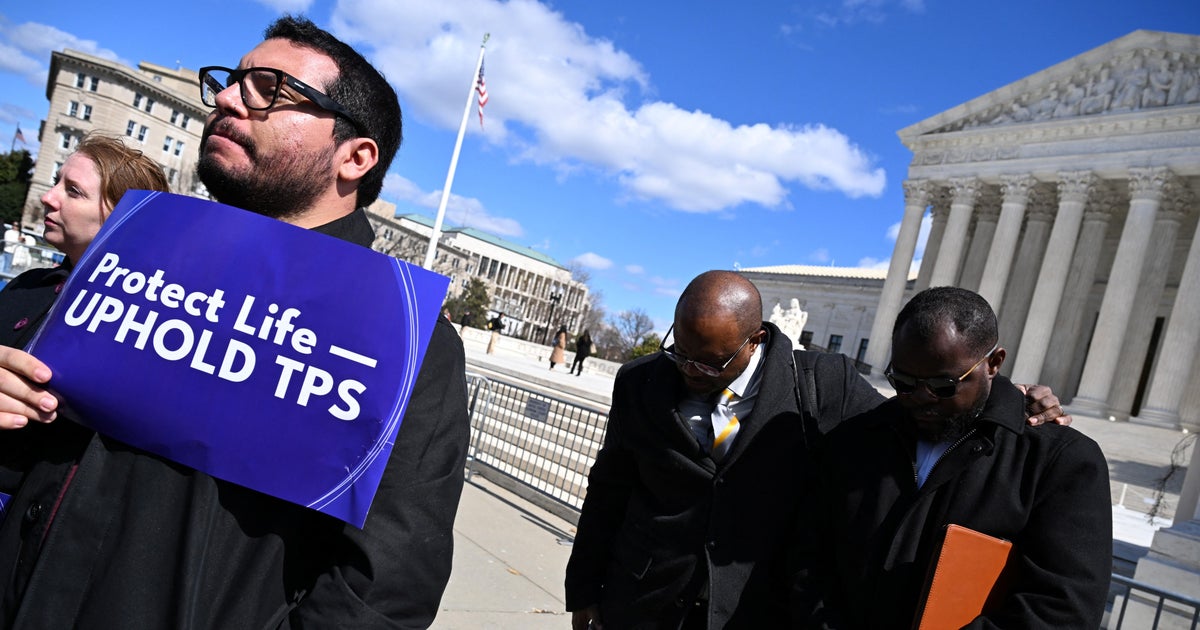
The Supreme Court will weigh whether the Trump administration can end Temporary Protected Status for more than 6,000 Syrians and 350,000 Haitians, a ruling that could affect over 1 million immigrants across multiple TPS designations. Lower courts blocked the terminations, citing possible political influence and anti-Haitian animus, while the administration argues the law bars judicial review and that Syria and Haiti no longer qualify. The case is primarily a legal and policy development, with limited direct market impact but broader implications for immigration and executive authority.
The market relevance is not the immigration headline itself but the precedent on executive discretion: a Supreme Court ruling that narrows judicial review would materially widen the policy-beta of a second Trump term. That increases the probability of faster, less reversible administrative actions across immigration, labor, and parts of social policy, which is modestly negative for industries reliant on stable low-cost labor and predictable work authorization. The first-order equity impact is small, but the second-order effect is a higher volatility regime for payroll-sensitive sectors as employers price in greater staffing churn and compliance risk.
The more important near-term trade is on the legal-process channel. If the Court blesses broad insulation from review, the administration gains a template to accelerate removals or status rollbacks with fewer procedural frictions, tightening labor supply in hospitality, food processing, elder care, agriculture, and construction over the next 2-6 quarters. That is inflationary at the margin for labor-intensive subsectors and could create selective upside for staffing firms, automation vendors, and contractors with pricing power, while pressuring consumer-facing names that are already margin-constrained.
The contrarian angle is that the immediate economic footprint is still too small to justify a broad macro trade: the direct affected population is not large enough to move aggregate labor data materially in the next few prints. The better setup is dispersion, not index-level positioning. The litigation itself also creates a binary catalyst structure—any hint the Court preserves review preserves the status quo and removes the urgency premium embedded in some immigration-sensitive industries.
For EM, the signal is a reminder that U.S. policy risk toward fragile sovereigns remains highly path-dependent. If the administration can more easily unwind humanitarian protections, it modestly raises tail-risk premia on countries whose remittance and diaspora ties matter to consumption, but the effect is more narrative than pricing unless it spills into broader visa/work authorization categories.
AI-powered research, real-time alerts, and portfolio analytics for institutional investors.
Request DemoOverall Sentiment
mildly negative
Sentiment Score
-0.20
