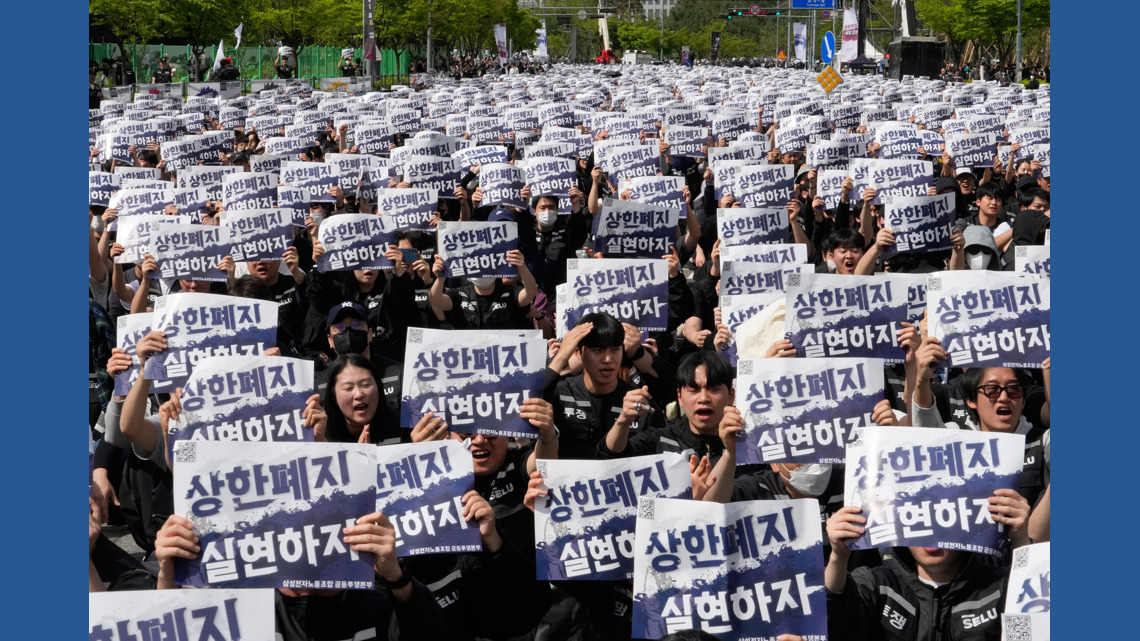
Samsung workers, representing about 74,000 employees, rallied for higher bonuses and threatened an 18-day walkout starting May 21, potentially costing the company more than 1 trillion won ($676 million) per day. The dispute comes as AI-driven demand is boosting memory-chip profits, with Samsung forecasting first-quarter operating profit of 57.2 trillion won ($38.6 billion) and SK Hynix posting record quarterly revenue and operating profit of 37.6 trillion won ($25.4 billion). The article also flags supply-chain risks from Middle East conflict, including helium and bromine sourcing for chipmaking.
The market is likely underpricing how quickly labor unrest can convert AI-driven margin expansion into a margin redistribution story. In memory, pricing power is still intact, but when labor starts demanding an explicit share of extraordinary profits, it becomes a template risk for other high-concentration semiconductor employers in Korea and Taiwan, especially where tight supply emboldens employees to push for variable compensation. That means the next-order effect is not just one company’s wage expense; it is a broader re-rating of operating leverage assumptions across the memory complex.
The bigger near-term catalyst is timing risk, not demand risk. An 18-day disruption window would matter disproportionately because memory supply chains are already running with limited slack, and even a credible strike threat can force customers to accelerate spot buying, dual-source where possible, or pre-build inventories. That could temporarily benefit adjacent suppliers with less labor tension or more diversified fabs, while raising the probability of a sharp but short-lived move higher in memory pricing if shipments are interrupted in May/June.
The geopolitical supply issue is a slower-burn margin risk but with asymmetric upside for non-Middle East sourcing and inventory-heavy operators. If energy and specialty-gas input costs rise, the first companies to feel it will be those with the weakest procurement diversification and the longest replenishment cycles; the market often misprices this because the initial production commentary stays calm until inventories roll off. The contrarian view is that the labor headline may be more bark than bite for a cash-rich incumbent, but the combination of wage pressure plus AI capex intensity makes the cycle less “supernormal margin” than consensus assumes.
AI-powered research, real-time alerts, and portfolio analytics for institutional investors.
Request TrialOverall Sentiment
neutral
Sentiment Score
0.05
