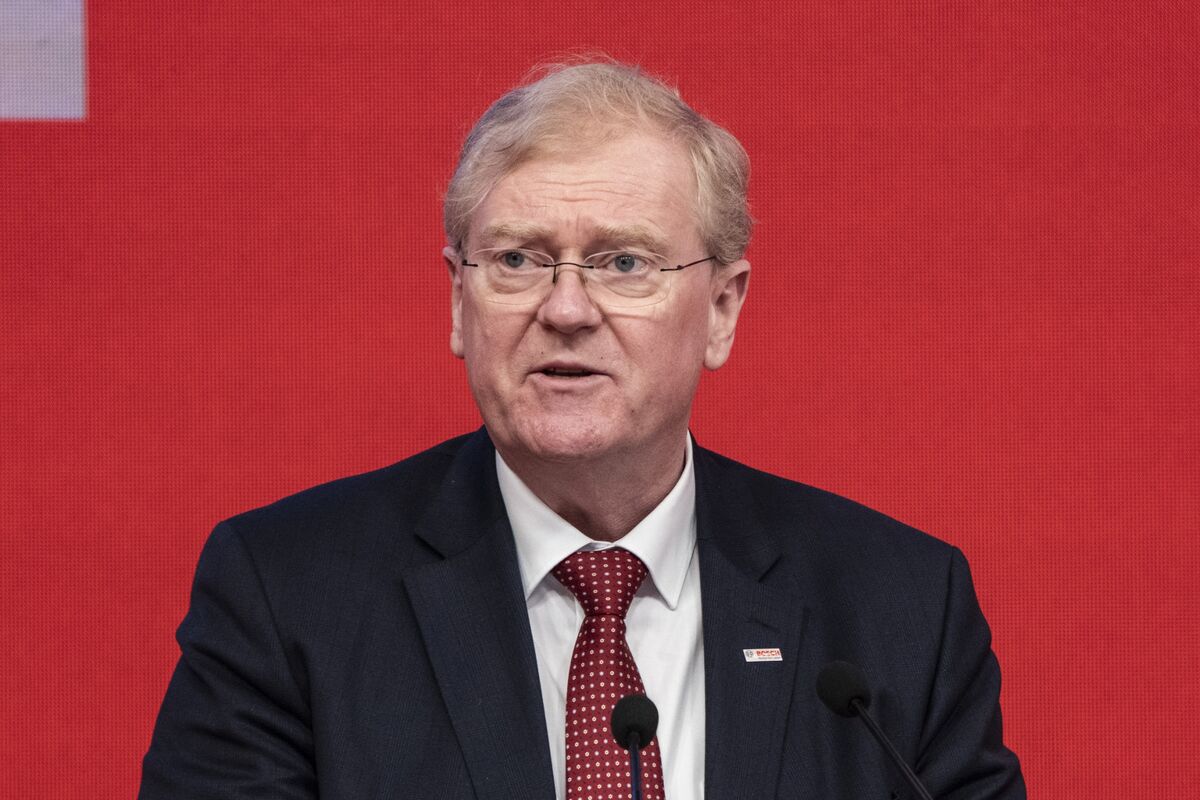
Bosch CEO Stefan Hartung is stepping down after leading a push to cut thousands of jobs and improve competitiveness at the world’s largest car-parts maker. Deputy CEO Christian Fischer, 58, will replace him on July 1. The move is largely a leadership transition, with limited immediate market impact absent new financial guidance or strategic changes.
This looks less like a generic CEO change and more like a sequencing problem for a company in the middle of a multi-year cost reset. The main second-order risk is that leadership turnover right after a headcount/capex rationalization phase often slows execution at the exact moment when credibility with suppliers, labor councils, and OEM customers matters most. That tends to benefit leaner Tier-1s and pricing-disciplined competitors, while hurting any supplier whose margin recovery depends on sustained restructuring discipline rather than top-line growth.
The market implication is not an immediate demand shock, but a governance premium shift over the next 6-12 months. Successor transitions in complex industrials usually create a window where procurement teams and customers test for concessions, especially if the outgoing CEO was the sponsor of layoffs and productivity initiatives. If the new CEO is perceived as more consensus-driven, expect slower margin expansion and potentially more generous customer terms; if he doubles down on restructuring, the near-term optics may be weaker but the medium-term EBITDA profile improves.
The contrarian angle is that this may be additive rather than disruptive if the board is deliberately locking in the restructuring playbook before macro weakness shows up in auto volumes. In that case, the move is not a sign of instability but a transition from cost-cutting to execution, which can de-risk earnings relative to peers still carrying excess fixed cost. The key watch item is whether management guidance on mix, pricing, and labor cost remains stable through the next two quarters; any slippage there would matter more than the headline departure itself.
From a broader automotive supply-chain lens, this is mildly negative for higher-cost component suppliers and neutral-to-positive for OEMs and lower-cost competitors who can exploit procurement pressure. If the transition leads to slower innovation spending, that can also create a longer-term opening for more agile EV-dedicated suppliers to gain share in power electronics, thermal systems, and software-integrated components.
AI-powered research, real-time alerts, and portfolio analytics for institutional investors.
Request DemoOverall Sentiment
neutral
Sentiment Score
-0.10
