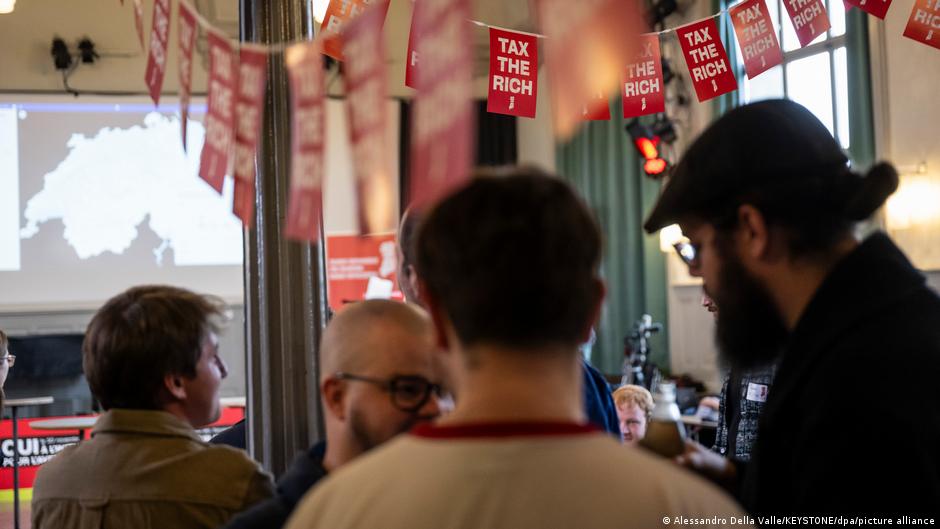
Swiss voters decisively rejected a proposal from the Young Socialists to impose a 50% inheritance tax on estates worth 50 million CHF or more, with final results showing over 78% against the measure; a separate civic-service mandate was also turned down by 84.2% of voters. The federal government and parliament had opposed both initiatives, and the results reduce the near-term likelihood of major redistributive or climate-financing tax changes in Switzerland, limiting direct market implications for investors.
Market structure: The referendum outcome preserves the status quo for Switzerland’s high-net-worth base, a modest positive for listed Swiss wealth managers and luxury-facing domestic services because it removes a potential one-off asset reallocation shock; expect a 1–3% positive earnings-sentiment tail for UBS (UBS) and Julius Baer (BAER.SW) over 1–3 months if inflows hold. Competitive dynamics remain favourable to Swiss private banks — pricing power in wealth-management fees is unchanged and potential client relocation costs are avoided, so market share shifts away from non-Swiss boutiques are capped. Cross-asset: near-term CHF appreciation of ~0.5% vs EUR/CAD is plausible from avoided outflows; Swiss sovereign bonds and CDS see negligible credit impact but FX and equity implied vols should compress slightly in days-to-weeks.
Risk assessment: Tail risks include repeat initiatives or canton-level levies, EU/OCED tax coordination that could bypass Swiss safeguards, or a major bank reputational shock that re-triggers outflows (low-probability, high-impact). Immediate (days) effects: sentiment bump in wealth-management names and CHF; short-term (weeks/months): capital-flow adjustments and Q4 guidance revisions; long-term (quarters/years): persistent political risk since Swiss referenda can recur and could force alternative fiscal measures. Hidden dependencies: global luxury consumption and cross-border tax treaties drive flows more than domestic votes; catalysts to reverse the trend include EU policy moves, large asset-manager reallocations, or a Swiss political shift within 6–18 months.
Trade implications: Direct: initiate tactical long exposure to UBS (UBS) 2–3% portfolio weight and Julius Baer (BAER.SW) 1–1.5% weight, size to risk budgets and trim on +10% moves within 1–3 months. Pair: long UBS / short Deutsche Bank (DB) 0.5–1% notional for 3–6 months to express wealth-management premium over universal-bank cyclicality. FX/options: short EUR/CHF targeting a 0.5–1% move with a 1% stop-loss over 2–6 weeks; implement a cost-limited call spread on UBS (3-month, 8–12% OTM buy/sell) if seeking leveraged upside while capping premium outlay. Rotate modestly into Swiss luxury retailers and real-estate developers (exposure cap 2%) on any CHF strength dip.
Contrarian angles: Consensus treats this as non-event; underappreciated is that rejection reduces urgency for green fiscal funding in Switzerland, potentially slowing Swiss sovereign / cantonal green-bond supply and creating short-term scarcity in EUR/CHF hedged green fixed income. Another missed point: wealthy clients still face rising international transparency — incremental regulatory headwinds abroad could still pressure Swiss bank flows despite this vote, so avoid levered, concentrated positions. Historical parallels (repeat referenda driven volatility) argue for sizing at 1–3% per name and hedging FX exposures to avoid episodic reversals within 6–18 months.
AI-powered research, real-time alerts, and portfolio analytics for institutional investors.
Request DemoOverall Sentiment
neutral
Sentiment Score
0.08
