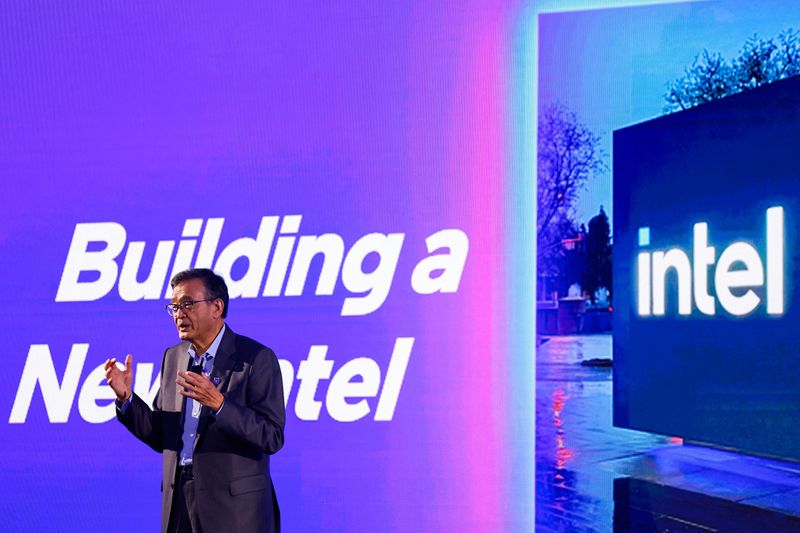
Intel CEO Lip-Bu Tan is heading to Taiwan for meetings with TSMC management ahead of his June 2 COMPUTEX keynote, reinforcing speculation about Intel’s foundry strategy and potential cooperation. The article highlights Intel’s roughly $614 billion market cap, but also the large operational gap versus TSMC, which generated $35.9 billion in Q1 2026 foundry revenue versus Intel Foundry’s $5.4 billion. The tone is cautiously constructive for Intel’s strategic optionality, though the piece emphasizes uncertainty and ongoing debate over whether deeper collaboration would help or hurt foundry independence.
The market is treating this as a broad semiconductor-positive signal, but the cleaner read is a relative-value setup inside the foundry ecosystem. Intel gets the biggest marginal boost from any visible validation of its manufacturing roadmap, yet that same validation is exactly what TSMC would rationally sell only if it comes with capacity-sharing, packaging, or geopolitical insurance value rather than true process dependence. In other words, the more this dialogue progresses, the more it should be read as an optionality event for Intel and a pricing-power event for TSMC, not a binary win for both.
The second-order effect is supply-chain repricing: if Intel can credibly externalize even a small fraction of high-end wafer demand over the next 12-24 months, tool vendors, advanced packaging players, and domestic substrate suppliers could get a larger incremental boost than either headline equity. Conversely, if talks stall, Intel’s multiple likely compresses faster than the stock would suggest because the recent rally has front-loaded a lot of execution optimism without proof of customer-grade yield. The government stake adds a governance overhang: it may reduce downside by signaling support, but it also narrows strategic flexibility and raises the odds of politically influenced capital allocation.
For TSMC, the near-term upside is more muted because it already enjoys the strongest strategic position and is not reliant on Intel to improve its own growth path. The real risk for TSM is not partnership dilution; it is attention dilution — any partnership narrative that gives Intel a domestic manufacturing halo could slightly soften the scarcity premium attached to TSMC’s advanced-node dominance. That said, the most likely outcome remains cooperative coexistence, which supports a stable-to-positive backdrop for the whole AI semiconductor complex.
Consensus is probably overestimating how quickly rhetoric can translate into foundry share. The key variable is not the meeting itself but whether Intel can demonstrate consistent yields and defect control over multiple quarters; that is a months-long process, not a headline-driven one. If there is no concrete customer announcement or roadmap validation by the next earnings cycle, the stock could give back a meaningful portion of the move as the market rotates from story to proof.
AI-powered research, real-time alerts, and portfolio analytics for institutional investors.
Request DemoOverall Sentiment
mildly positive
Sentiment Score
0.15
Ticker Sentiment
