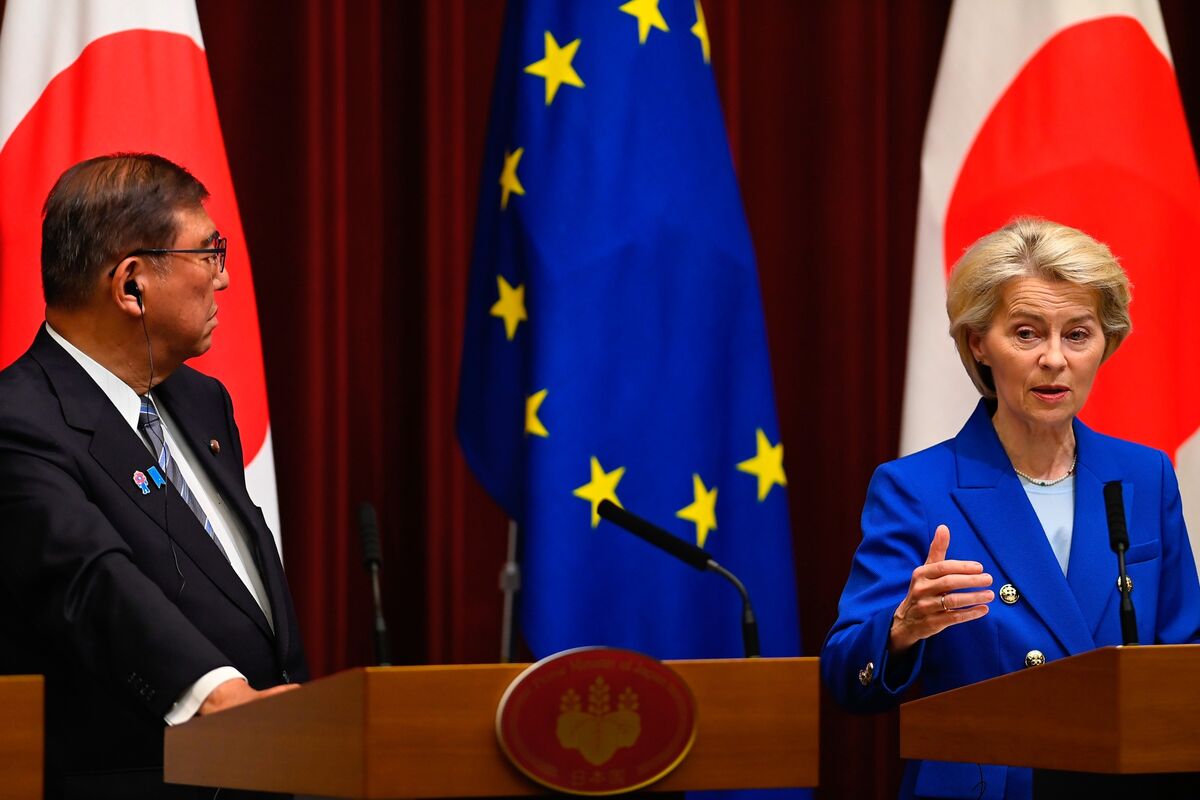
Japan and the European Union have announced a significant deepening of economic and defense cooperation, forming a "competitive alliance" aimed at bolstering a stable, rules-based global economic order. This strategic move comes as both regions navigate complex relationships with the US, particularly in light of US tariffs impacting Japan, and address shared challenges posed by China, signaling a potential realignment of global trade and security dynamics.
Japan and the European Union have formalized a 'competitive alliance' to deepen economic and defense industry cooperation, a strategic move explicitly aimed at fostering a stable, rules-based global economic order. This partnership is a direct response to shared geopolitical pressures, namely the impact of US tariffs and strategic challenges posed by China. Market sentiment reflects this realignment, with positive scores for Japanese (EWJ, +0.6) and European (IEUR, +0.6) ETFs indicating investor optimism about enhanced trade and industrial integration. Conversely, the negative sentiment registered for US (SPY, -0.4) and Chinese (MCHI, -0.5) ETFs suggests the alliance is perceived as a strategic counterbalance that could introduce new trade frictions and geopolitical headwinds for both Washington and Beijing. The pact's focus on creating a 'predictable' framework signals a potential long-term shift in global trade policy and supply chain configurations, favoring a more integrated Japan-EU bloc.
AI-powered research, real-time alerts, and portfolio analytics for institutional investors.
Request DemoOverall Sentiment
moderately positive
Sentiment Score
0.55
Ticker Sentiment
