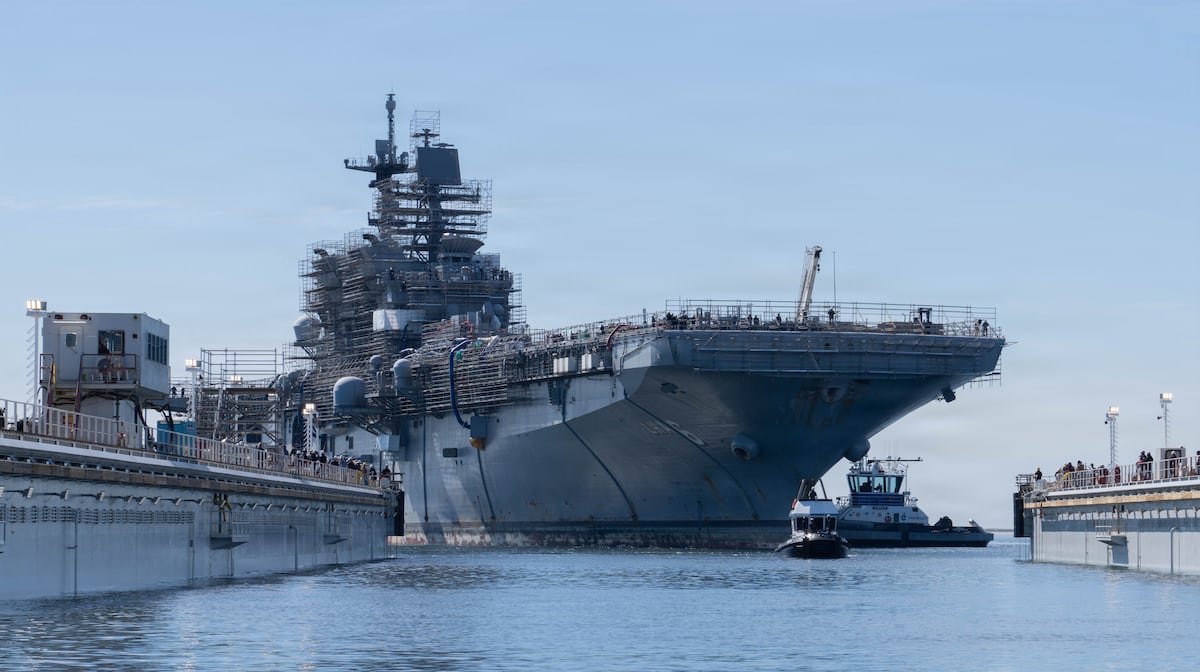
The U.S. Marine Corps says its current inventory of 31 amphibious ships is insufficient, with only four deployed as of April 2026 and readiness falling to 41% in 2025. The Navy and Marine Corps plan to improve availability through maintenance optimization, service-life extensions, and new ship procurement, supported by the proposed FY2027 budget and Congress. The effort reflects heightened operational demand in the Middle East, Latin America, the Caribbean, and the Indo-Pacific.
This is less a one-off budget headline than a multi-year capacity reset for a niche naval-industrial segment with very low elasticity. The key second-order effect is that once operational availability becomes a stated national-security gap, procurement moves from discretionary to semi-protected, which should improve backlog visibility for shipyards, propulsion, combat-systems, and depot-maintenance vendors even if top-line contract awards are lumpy. The near-term bottleneck is not demand but throughput: skilled labor, dry-dock access, and supplier qualification will likely be the binding constraints, so margin upside accrues first to contractors with maintenance-heavy exposure rather than pure newbuild names.
The market is likely underappreciating the asymmetry between repair/sustainment work and new construction. Service-life extensions and schedule optimization favor vendors with MRO, integration, and parts inventory depth, while the real option value sits in companies that can scale into a longer procurement cycle without major capex overruns. A sustained amphibious recapitalization also tends to pull forward orders for auxiliary systems—engines, power management, mission electronics, command-and-control, and landing craft—creating second-order winners beyond the headline shipbuilders.
From a timing standpoint, the first catalyst is budget language and appropriations discipline over the next 1-3 quarters; the second is contracting cadence over 12-24 months; the third is actual yard throughput, which is where programs often slip. The main tail risk is political reversal if deficits force prioritization away from naval recapitalization, or if a broader easing in geopolitical tensions reduces urgency. Another risk is execution failure: if readiness remains weak despite more funding, the narrative shifts from scarcity to inefficiency, compressing multiples for the prime contractors.
AI-powered research, real-time alerts, and portfolio analytics for institutional investors.
Request TrialOverall Sentiment
neutral
Sentiment Score
0.05
