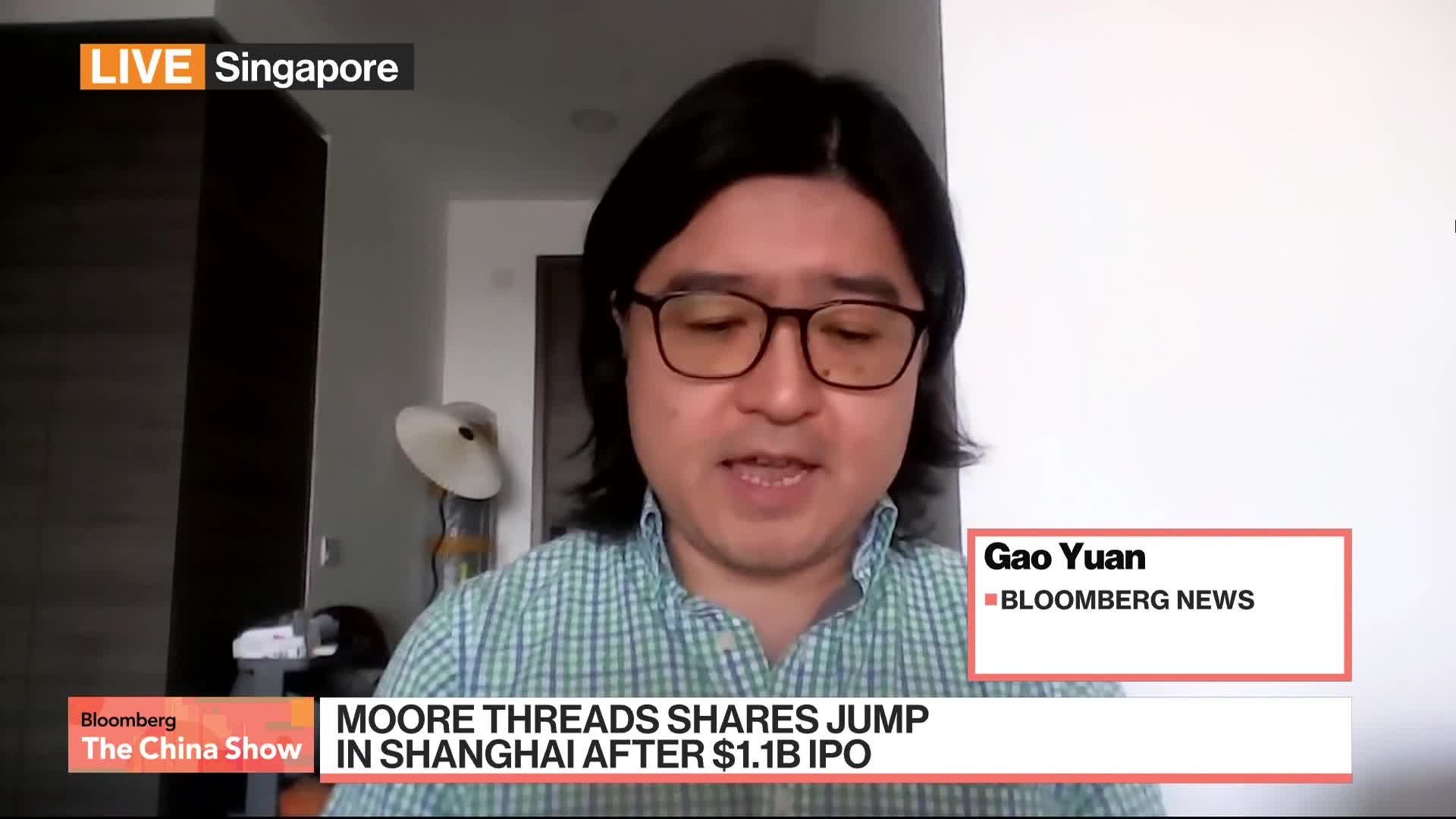
Moore Threads priced strongly in its IPO amid investor excitement as a hopeful Chinese GPU designer targeting AI acceleration, though it designs GPUs and does not fabricate chips. Near-term sales and scale are expected to be limited versus Nvidia, Cambricon and Huawei because it relies on domestic foundries (e.g., SMIC) with constrained sub‑7nm capacity; the IPO proceeds are intended to fund R&D and position the company as a longer‑term contender in China's drive for semiconductor independence.
Market structure: Moore Threads' IPO hype mostly redistributes near-term investor attention to China’s GPU race but does not meaningfully alter global advanced-node demand. Winners in the next 6–12 months are incumbent GPU leaders (NVDA) and advanced foundries (TSM) that retain sub-7nm capacity and pricing power; losers are small Chinese fabless GPU hopefuls without foundry access. Constrained sub‑7nm capacity (SMIC capacity <30% of TSMC’s advanced output in 2025 by most estimates) implies sustained price elasticity favoring premium nodes and higher gross margins for TSM/NVDA customers.
Risk assessment: Tail risks include tightened US export controls (30–90 day regulatory shocks), rapid SMIC process gains, or large Chinese subsidies (>USD 5–10bn) that materially accelerate domestic scaling; each could compress or re-route market share within 12–36 months. Immediate risk (days) is an IPO pop/mean reversion; short term (weeks–months) is execution risk on foundry contracts and EDA/toolchain lock‑in (CUDA dependency); long term (3+ years) is government procurement programs forcing local adoption. Hidden dependency: software stack (CUDA-equivalent) and access to Synopsys/Cadence — without them silicon is functionally limited.
Trade implications: Tactical direct plays: establish a 2–3% overweight in NVDA (ticker NVDA) with a 6–12 month target +20% and stop-loss -10%; establish 1.5–2% long in TSM (TSM) with a 6–12 month target +15% to capture foundry pricing tailwinds. Options: buy NVDA 3‑month 10% OTM call spreads sized to 1% portfolio risk to capture post-earnings upside while limiting premium; pair trade long NVDA vs short newly listed/illiquid Chinese GPU small‑caps (or Moore Threads if tradable) 1:1 to express quality spread. Keep INTC exposure small (0.5–1%) as a conditional 12–36 month play if Intel’s foundry wins tangible China contracts.
Contrarian angles: The market is underestimating two outcomes: (1) that Moore Threads’ near-term commercial traction will stay minimal absent sub‑7nm access, making the IPO pop fragile within 30–90 days; and (2) that strong government subsidies could create a slow, expensive domestic adoption curve (similar to 2010s Chinese memory) over 3–5 years, which would fragment GPU standards and raise TCO, benefiting NVDA’s ecosystem moat. Position accordingly: short-term fade of IPO exuberance, long-term hedge for forced-localization risk to incumbents.
AI-powered research, real-time alerts, and portfolio analytics for institutional investors.
Request DemoOverall Sentiment
mildly positive
Sentiment Score
0.25
Ticker Sentiment
