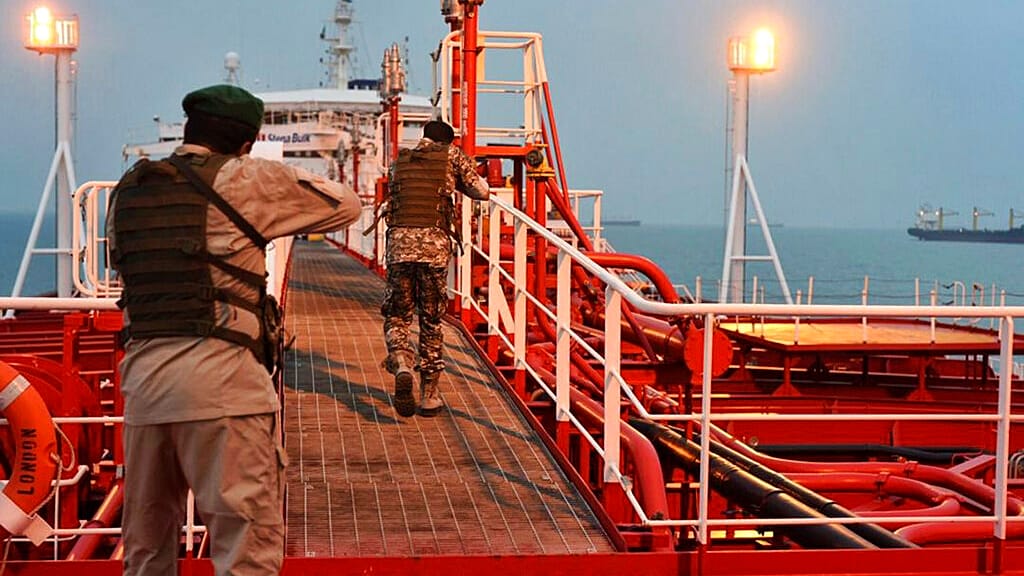
Iranian Revolutionary Guard naval forces seized a foreign oil tanker in the Strait of Hormuz carrying approximately 4 million litres of fuel and detained 16 foreign crew members; the vessel's flag and crew nationalities were not disclosed. The seizure underscores persistent risks to a chokepoint that handles about one-fifth of globally traded oil and one-quarter of seaborne oil, adding near-term upside pressure on oil-price volatility and elevating geopolitical risk for shipping and energy markets. Investors should monitor further regional escalations, additional seizures, and any disruption to tanker traffic that could influence oil supply sentiment and insurance/shipping costs.
Market structure: A seizure like this is a directional shock to risk premia rather than physical barrels — 4 million litres ≈ 25,000 barrels (negligible vs daily ~100m bbl global flow) but it raises security/insurance premia. Winners: spot tanker owners (FRO, STNG, EURN), P&I insurers, oil producers with spare capacity (XOM, CVX); losers: short‑haul refiners, container/logistics operators and regional trade corridors as rerouting increases voyage time and cost. Expect charter rates and insurance (war risk) spreads to reprice in the near term by 10–50% depending on incident cadence.
Risk assessment: Tail scenario — partial or full intermittent closure of Strait of Hormuz could produce >15–25% Brent spike within days and trigger EM FX shocks (NOK, AED) and insurance losses; probability low (<10%) but impact high. Immediate horizon (0–7 days): volatility spikes and flight‑to‑quality; short term (weeks–3 months): higher freight and insurance costs, widening credit spreads for exposed shippers; long term (3–24 months): permanent risk premium baked into tanker/defense and upstream capex. Hidden dependencies include IEA spare capacity, US/UK naval posture, and OPEC spare production; any OPEC counteraction (cuts/increases) is a key catalyst.
Trade implications: Tactical plays favor short‑dated oil upside and equities exposed to tanker dayrates and defense. Buy convexity (short‑dated call spreads on Brent/BNO) to capture >10% moves while avoiding long-dated carry. Rotate conservative equity exposure from global shipping/logistics into energy majors (XOM, CVX) and select tanker names (FRO, STNG, EURN) with 3–12 month holds; hedge with sovereign CDS/fund positions if EM contagion emerges.
Contrarian angles: The market often overshoots on headline seizures — 2019 Stena Impero caused only a short shock; US 5th Fleet presence and commercial rerouting capacity limit sustained physical shortages. Therefore prefer buying short‑dated volatility and selective equity exposures rather than long‑dated leveraged oil or broad energy allocations; selling calendar spread widenings (sell 9–12m vol vs buy 1–3m) can monetize expected mean reversion if no escalation within 60–90 days.
AI-powered research, real-time alerts, and portfolio analytics for institutional investors.
Request DemoOverall Sentiment
moderately negative
Sentiment Score
-0.35
