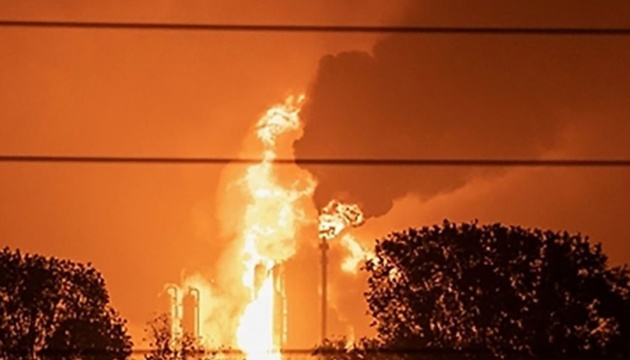
Drones attacked the Temryuk port in Russia’s Krasnodar region, igniting oil tanks and producing a fire of roughly 2,000 square meters while preliminary reports indicated no casualties. Russia’s MOD said air defenses downed 141 UAVs overnight (62 over Bryansk), and regional authorities reported damage to two berths, a pipeline and two ships; because the Temryuk terminal routes fuel to Black Sea and Mediterranean markets, the strikes risk near-term disruption to exports and add a modest risk premium to regional energy flows.
Market structure: The Temryuk/Temryuk-area drone strikes are a targeted hit on export infrastructure that could remove a near-term 50–200 kb/d of seaborne Russian crude if berths/pipelines stay offline for weeks, implying a short-lived Brent uplift of ~$1–3/bbl and crude volatility +15–30% in the next 7–14 days. Winners: global oil producers and oil services (slower Russian flows raise spot differentials for non-Russian barrels); losers: Russian exporters, Black Sea shippers, insurers, and airlines facing higher fuel costs. FX/bonds: expect RUB weakness and Russian sovereign/credit spreads to widen 50–200 bps; safe-haven flows to USTs and gold may rise modestly.
Risk assessment: Tail scenarios include escalation that forces broader Black Sea closures or a sustained 0.5–1.0 mb/d export shortfall — that would push Brent +$5–$12 and materially reprice energy and shipping risk premia. Time horizons: immediate (hours–days) = volatility spikes; short-term (weeks–months) = rerouting & insurance costs appear; long-term (quarters) = marginal shifts in seaborne trade lanes and OPEX for shippers. Hidden dependencies: marine insurance repricing and port repair timelines (contractor capacity) are the choke points; sanctions or retaliatory measures could amplify market dislocations.
Trade implications: Tactical: favor short-dated long oil exposures and selective defense exposure while hedging volatility. Structural: higher-for-longer oil supports energy capex and oilfield-services earnings over 3–12 months. Cross-asset plays: short RUB and Russian credit indices; long Baltic/charter-rate proxies if shipping disruption persists. Options: use defined-risk call spreads to capture upside while limiting theta bleed.
Contrarian angles: Consensus may overstate permanent supply loss — Temryuk throughput is a small slice of Russia’s ~4–4.5 mb/d export base, and repairs historically restore >80% capacity inside 4–8 weeks; initial oil spikes often mean-revert. That argues for buying short-dated volatility for hedges but selling expiries once mechanical repair timelines are confirmed. Unintended consequence: higher spot spreads could improve refinery margins in Europe/Med, benefiting selective refiners rather than broad commodity longs.
AI-powered research, real-time alerts, and portfolio analytics for institutional investors.
Request DemoOverall Sentiment
moderately negative
Sentiment Score
-0.45
