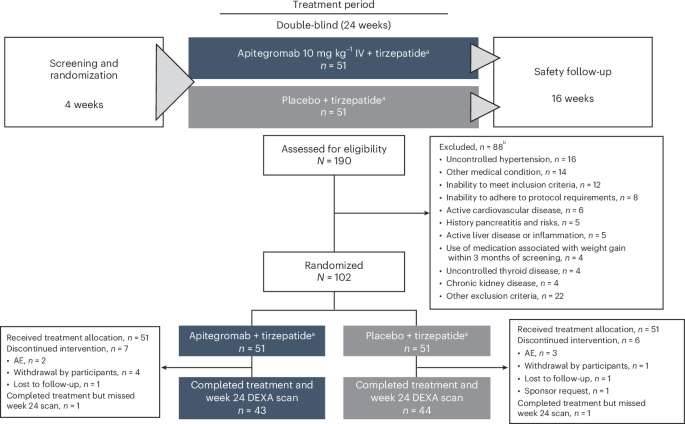
Apitegromab preserved 1.9 kg more lean mass than placebo at week 24 in the phase 2 EMBRAZE trial, while total weight loss remained similar between groups. Lean mass loss was 1.6 kg with apitegromab versus 3.5 kg with placebo, representing 54.9% retention of lean mass, and safety was broadly comparable with adverse events in 76% vs 71% of participants and one SAE in each arm. The data support proof of concept for selective myostatin inhibition alongside tirzepatide, but this is still an early-stage, small study with no near-term commercial catalyst disclosed.
This is a clean proof that the “weight-loss plus muscle-sparing” market can be monetized before anyone proves hard outcomes. The near-term implication is not just for obesity care; it broadens the addressable market for incretin therapies by reducing the main physiological objection from clinicians and payers: that rapid weight loss is partly paid for with functional tissue loss. That matters most for premium GLP-1 franchises, because the next leg of differentiation will shift from efficacy alone to composition quality, adherence, and post-treatment durability.
The second-order winner is whoever can package body-composition preservation as a companion to existing incretin regimens without materially worsening GI tolerability or administration burden. That creates a platform opportunity for obesity adjuncts, but it also raises the bar for oral or longer-acting competitors that cannot show a similar composition profile. For the core incretin leaders, this is mildly positive because it strengthens the long-duration obesity narrative and may improve persistence, but it is also a reminder that the category’s future margin pool may get shared with add-on biologics.
The main market risk is that this remains a surrogate-story until function and outcomes data arrive. Lean mass preservation is commercially useful only if it translates into better strength, less frailty, or lower discontinuation rates over 6-18 months; otherwise payers can treat it as an expensive cosmetic enhancement. There is also a likely reimbursement hurdle: if the add-on is priced like an orphan biologic, uptake will be limited to high-risk or premium self-pay populations, which caps the near-term TAM despite strong biology.
Consensus is probably underestimating how quickly this can alter combo-therapy R&D economics. A credible myostatin adjunct makes obesity drug development more modular: the base drug drives weight loss, while the add-on solves composition and may eventually become the premium layer in a two-drug stack. That is strategically positive for incumbents with distribution power and negative for smaller obesity entrants that lack a second mechanism to defend differentiation.
AI-powered research, real-time alerts, and portfolio analytics for institutional investors.
Request DemoOverall Sentiment
moderately positive
Sentiment Score
0.72
Ticker Sentiment
