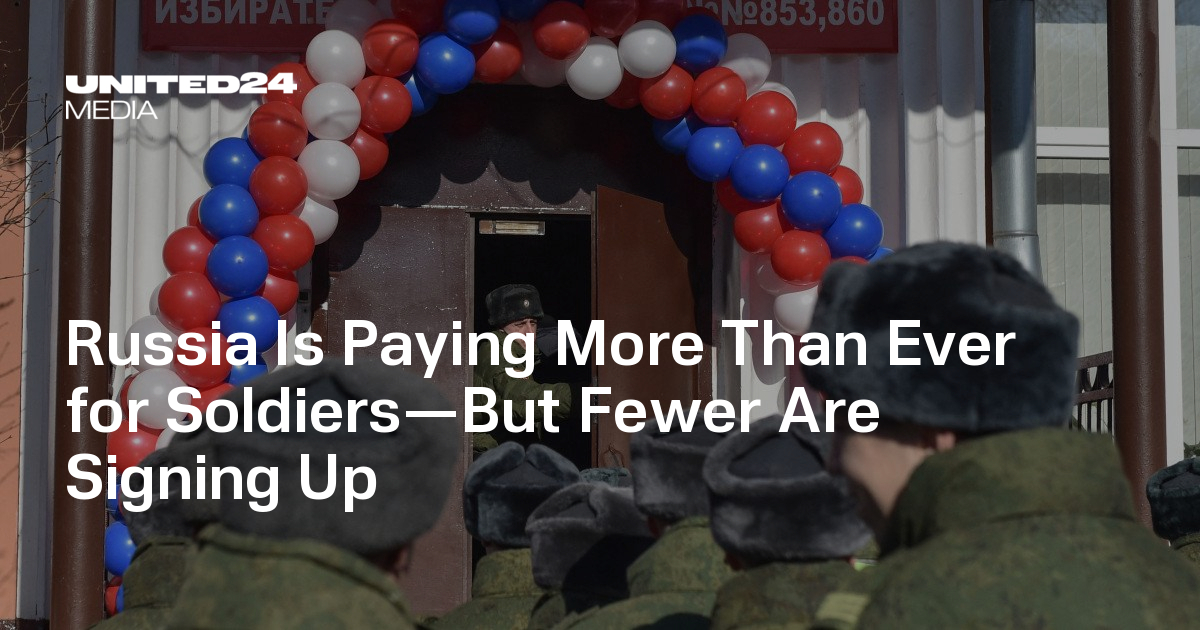
Russia’s contract soldier recruitment has slowed to about 800 recruits per day at the start of 2026, down from roughly 1,000 to 1,200 per day in early 2025, with declines of around 20% versus prior months. Average monthly recruitment is now about 30,000 troops, enough to offset battlefield losses but not expand the force materially. The Kremlin is leaning more heavily on cash incentives, including a doubled 400,000-ruble signing bonus and regional payouts that have pushed average bonuses to 1.47 million rubles in March, while some regions are spending up to 10% of budgets on recruitment.
The key second-order effect is not battlefield manpower, but fiscal crowding-out. Once recruitment becomes a quasi-auction, marginal soldiers are being financed by regional balance sheets that will have to trade off against wage support, utilities, and local capex; that means weaker subnational credit quality and less room for politically useful spending elsewhere. The pressure is asymmetric: poorer regions will either overbid to avoid quota risk or underfund recruitment and face administrative penalties, creating a widening dispersion in regional fiscal stress. For markets, the more important signal is that the war economy is getting more expensive per unit of force, which is typically the precursor to either higher central transfers or softer non-defense spending. That is mildly disinflationary for civilian demand over the next 6-12 months, but it is also pro-bond in the sense that the state is monetizing social pressure through targeted cash payouts rather than broad-based stimulus. The sustainability issue is not immediate collapse; it is a gradual erosion of optionality, where each incremental recruit costs more and yields less strategic elasticity. The contrarian read is that weaker recruitment is not necessarily de-escalatory. If the state can still replace losses, the incentive may be to intensify coercive mobilization and administrative conscription rather than negotiate, especially if leadership judges the fiscal pain as manageable. The more relevant trigger is a step-change in regional payment arrears or a visible reduction in bonus growth; either would imply the recruitment model is hitting funding limits and could force a policy pivot within 1-3 quarters.
AI-powered research, real-time alerts, and portfolio analytics for institutional investors.
Request DemoOverall Sentiment
mildly negative
Sentiment Score
-0.25
