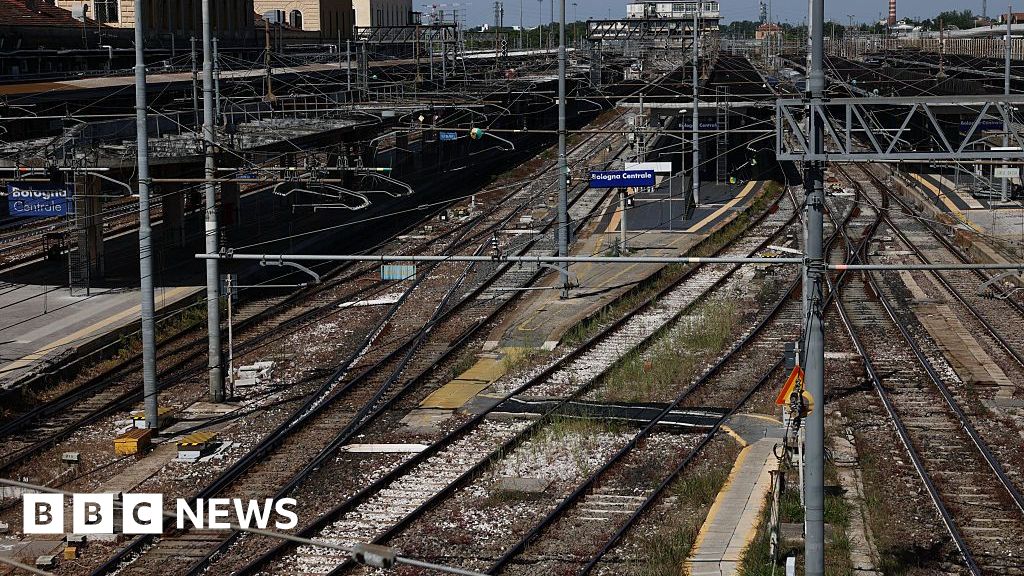
Multiple suspected sabotage incidents on northern Italy's rail network—including a fire between Bologna and Venice, a track switch set alight near Pesaro, severed electric cables and a rudimentary explosive device found near Bologna—caused significant travel disruption and delays of up to 2.5 hours as the Winter Olympic Games opened. Bologna's high-speed state rail hub was temporarily closed before services partly resumed; authorities, including Deputy PM and Transport Minister Matteo Salvini, linked the attacks to similar vandalism during the Paris Olympics, creating short-term operational, security and insurance considerations for rail operators and regional travel flows.
Market structure: Immediate winners are European security/defense contractors and rail-equipment suppliers (Leonardo LDO.MI, Thales HO.PA, Alstom ALO.PA) because governments typically accelerate procurement after infrastructure sabotage; losers are short‑haul travel & rail operators (RYA.L, IAG.L, TUI1.DE) with 5–15% near‑term demand hit during event windows and possible re-routing costs. Pricing power shifts modestly to incumbents able to provide rapid signalling, CCTV and hardened power cabling; private operators absorb disruption costs and face higher insurance premia. Cross‑asset: expect a risk‑off knee‑jerk — BTP/Bund spreads +10–30bps intraday, EUR down 0.3–1.0% vs USD, and bump in European short‑dated implied vol (V2X) by 20–50% for 1–4 weeks. Risk assessment: Tail scenarios include an escalation to a coordinated campaign (high‑impact, low‑probability) that could widen BTP/Bund spreads >100bps and force travel cancellations across northern Italy, or a political backlash raising transport regulation and capex mandates. Immediate (days) risks are operational disruption and volatility spikes; short term (weeks–months) are contract reprioritisation and insurance claims; long term (quarters–years) is structural uplift in security capex benefiting defense/systems integrators. Hidden dependencies: federal procurement cycles, EU funding windows, and insurer solvency thresholds; catalysts include claims of responsibility, repeat incidents, or formal procurement announcements within 30–90 days. Trade implications: Favor 3–12 month longs in LDO.MI and HO.PA (security systems) and ALO.PA (signalling), size 1–3% each, and deploy short‑dated hedges on travel names (buy 1–3 month put spreads on RYA.L and IAG.L). Pair trades: long Alstom (ALO.PA) vs short TUI1.DE to express capex beneficiaries vs consumer travel sensitivity over 3–9 months. If BTP/Bund 10y spread >50bps sustained 48h, rotate 3–5% into German bunds and buy protection on Italian banks (e.g., ISP.MI puts). Contrarian angles: Consensus focuses on immediate tourism hit but underestimates reinstated capex — security upgrade programs can add mid‑single‑digit percent revenue to contractors over 12–24 months. Market may overprice travel downside: if no repeat events in 7–14 days, expect 15–25% snapback in beaten airline/tourism stocks. Historical parallel: Paris 2024 rail sabotage produced transient equity weakness but durable procurement tailwinds for suppliers; mispricing window likely closes within 4–8 weeks.
AI-powered research, real-time alerts, and portfolio analytics for institutional investors.
Request DemoOverall Sentiment
moderately negative
Sentiment Score
-0.35
