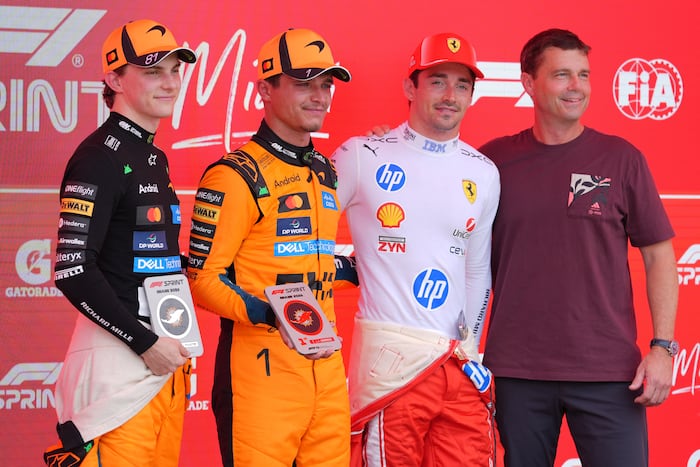
McLaren finished 1-2 in the Miami Grand Prix sprint race, with Lando Norris winning from pole and Oscar Piastri second, while Charles Leclerc was third. Mercedes was knocked off the podium for the first time this season as George Russell placed fourth and Kimi Antonelli sixth after a penalty, indicating McLaren has closed the performance gap following car upgrades. The result is meaningful for Formula 1 competitive positioning but is unlikely to move broader markets.
The market implication is less about a single sprint result and more about a visible regime shift: the leader’s edge is no longer static, and in F1 that usually means the fastest team on incremental development over the next 4-8 weeks compounds advantage quickly. For a listed exposure like RACE, the key isn’t race-by-race podium optics; it is whether the brand stays embedded in the title conversation and preserves pricing power around premium road-car demand and sponsor/merchandise flywheel. A sustained McLaren step-up is mildly negative for Ferrari’s track narrative, but not yet enough to alter the equity story unless it turns into a multi-race dominance streak.
The second-order read is that the upgrade reset compresses performance variance across the front half of the grid, which tends to increase incident risk, penalties, and strategic error rates. That matters because smaller gaps usually create more volatility in results, and volatility is where brand engagement spikes but championship certainty falls; for RACE, that can be a double-edged sword if Ferrari remains competitive without actually converting wins. The broader supply-chain angle is also constructive for the sport ecosystem: faster iteration cycles imply higher spend on engineering, simulation, and component procurement, which supports the technology-services layer around the series rather than any one team.
The contrarian view is that investors may be over-weighting the headline podium change and under-weighting how quickly Mercedes can respond once the upgrade race is explicit. In other words, this is more likely a compression of the leader’s moat than a durable dethroning. The actionable setup is to use any post-race enthusiasm in Ferrari-linked sentiment as an opportunity to own into the next upgrade cycle rather than chase it; the real risk to the bullish view is if McLaren converts this into a two- to three-race sequence, because then the narrative shifts from parity to momentum, and momentum tends to matter more for near-term positioning than raw points.
AI-powered research, real-time alerts, and portfolio analytics for institutional investors.
Request DemoOverall Sentiment
mildly positive
Sentiment Score
0.15
Ticker Sentiment
