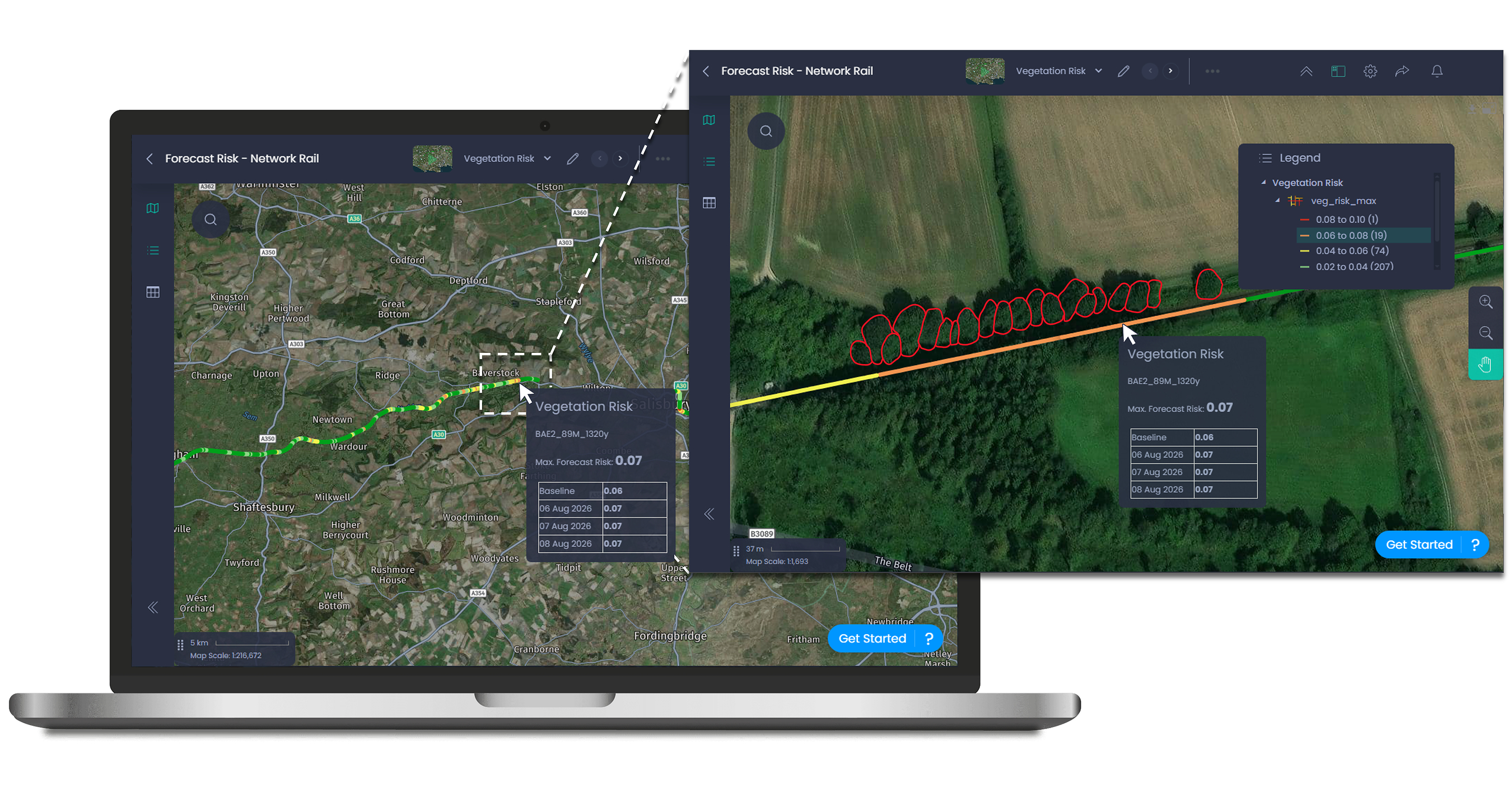
Network Rail and CATALYST (PCI Geomatics) completed a 12-week pilot using satellite imagery, InSAR analysis, and short-term weather forecasts to generate rail risk insights up to 3 days ahead for Wessex. The prototype produces location-specific risk indicators for 3 hazard types—ground deformation, vegetation fall, and flooding—supported by a web dashboard updated daily across three rail segments. Early user feedback broadly matched known risk areas and highlighted tree-fall risk as particularly valuable, with potential to enable more frequent, data-driven vegetation monitoring than the current 3-year cycle.
This is less a one-off rail tech story than a proof-of-concept for turning climate exposure into a recurring software/data budget. The economic value sits in shifting spend from infrequent, human-intensive inspections toward always-on risk scoring, which should favor geospatial analytics, satellite-data, and workflow-integration vendors over field-survey labor over the next 1-3 years. The near-term P&L impact for the rail operator is limited, but the strategic value is meaningful if it reduces disruption compensation, emergency callouts, and conservative speed restrictions.
The second-order winner is any provider that can bundle imagery, weather, and decision workflows into a procurement-friendly product; the hidden loser is commoditized inspection and vegetation-management work that gets pushed out of the highest-value part of the chain. The main risk is validation: one missed flood or treefall during a material weather event would sharply slow adoption, while too many false positives would raise operating costs by forcing unnecessary restrictions. Over the next 1-3 months, the key catalyst is whether this stays a pilot or becomes a funded rollout; over 6-18 months, watch for extension into other rail corridors and adjacent infrastructure markets.
Contrarian view: the market may be underestimating how quickly regulated operators buy resilience once they have a credible workflow, but it may also be overestimating near-term revenue because pilots rarely convert cleanly into large ACV. The tradeable edge is not the press release itself; it is early evidence of procurement language, renewal cadence, and whether the EO stack can be embedded into existing asset-management systems rather than remaining a nice-to-have overlay.
AI-powered research, real-time alerts, and portfolio analytics for institutional investors.
Request DemoOverall Sentiment
mildly positive
Sentiment Score
0.25
