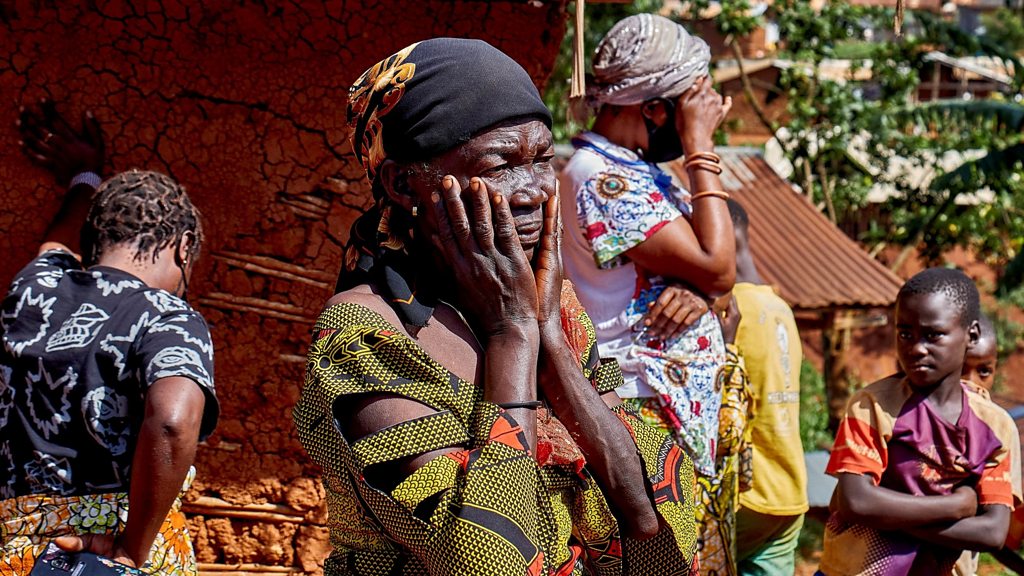
Ebola has been declared a public health emergency of international concern and is spreading in DR Congo's North and South Kivu provinces, with seven confirmed cases reported in neighboring Uganda. The article highlights increasing disruption to burial traditions, including incidents where crowds tried to reclaim bodies from treatment centers in Mongwalu and Rwampara. The outbreak raises meaningful public health and regional containment risks across East Africa.
The immediate market read is not on Ebola case counts themselves, but on the behavioral premium attached to disease control credibility. Once burial practices become the flashpoint, transmission management gets harder because compliance is socially, not just medically, constrained; that raises the odds of repeated localized flare-ups, longer containment windows, and more spend on field logistics, community outreach, and security around treatment sites. The first-order beneficiaries are not broad healthcare equities, but niche names tied to diagnostics, PPE, cold-chain, surveillance software, and humanitarian logistics that see accelerated procurement when response teams need to scale fast.
Second-order damage falls on cross-border commerce in the Great Lakes corridor. Even a contained outbreak tends to tighten border screening, slow informal trade, and suppress mobility-sensitive sectors for weeks to months, with the biggest impact on consumer staples distributors, regional banks, insurers, and airlines/freight operators with exposure to East/Central Africa. The market often underprices the earnings drag from “soft lockdown” behavior: lower foot traffic, higher cash preference, and delayed capex from local businesses persist after the headline case curve flattens.
The key catalyst is whether the episode stays operationally manageable or turns into a trust crisis. If local resistance to safe-burial protocols intensifies, response costs rise nonlinearly and the probability of export restrictions, border friction, and NGO pullbacks increases over the next 2-8 weeks. Conversely, rapid community engagement and visible containment would compress the risk premium quickly, so the trade is highly event-driven rather than a multi-quarter theme unless the outbreak spills further regionally.
The contrarian angle is that public health emergencies in Africa are often treated as a generic risk-off signal, but the investable impact can be narrow and temporarily mispriced. The bigger opportunity is not shorting broad EM, but leaning into suppliers with direct emergency-response exposure while avoiding local consumer and transport proxies that usually gap down on fear and then recover once containment headlines improve.
AI-powered research, real-time alerts, and portfolio analytics for institutional investors.
Request DemoOverall Sentiment
moderately negative
Sentiment Score
-0.45
