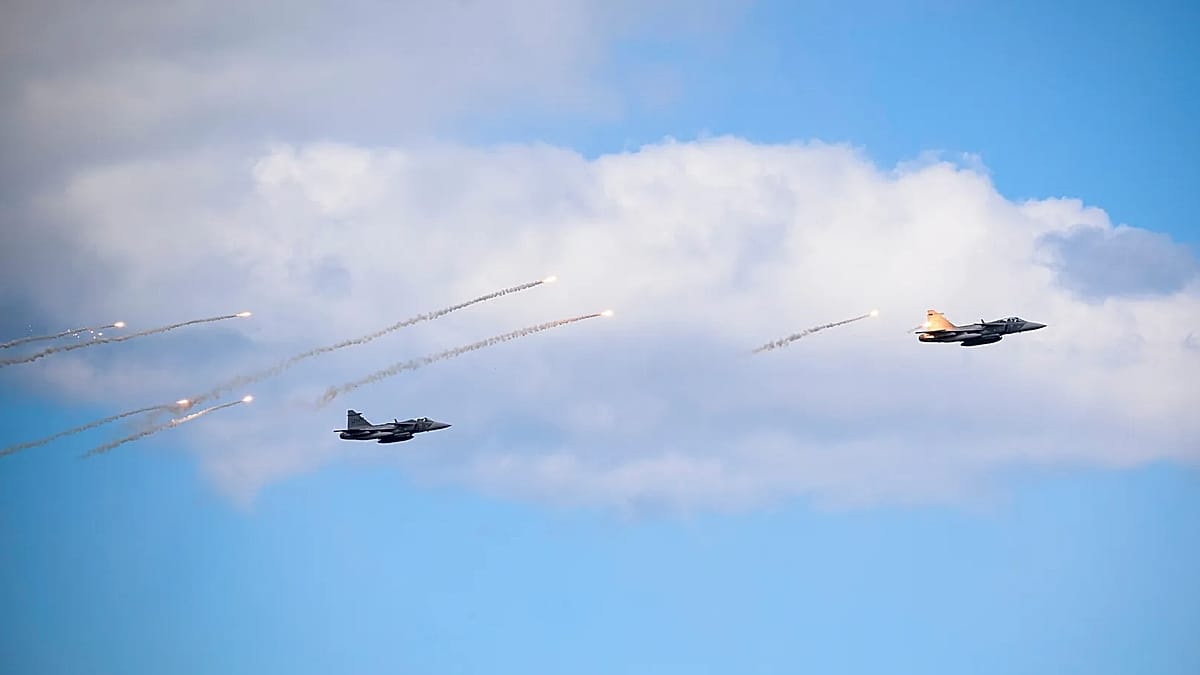
Ukraine plans to buy up to 20 Gripen E fighter jets, funding the new aircraft with €2.5 billion from an EU loan, while Sweden will donate 16 older Gripen jets with deliveries starting in early 2027. The broader Swedish aid package totals 25.2 billion kronor, and Sweden has now provided more than 128 billion kronor in military aid since Russia's invasion began. The announcement supports Ukraine's air defence capability but also underscores its ongoing reliance on Western support, including a pending U.S. response on additional Patriot missile systems.
This is less a pure defense headline than a signal that Europe is moving from emergency military aid toward medium-term industrial financing of Ukrainian airpower. That matters because the bottleneck is no longer only hardware availability; it is the conversion of sovereign and supranational funding into long-dated procurement commitments, which should support Nordic defense primes, mission-system integrators, and European weapons makers that can attach themselves to sustainment, training, and upgrade cycles. The initial order size is small relative to the stated end-state, but the option value is large: once pilot pipelines, maintenance infrastructure, and munitions integration are established, follow-on spending tends to become sticky for 5-10 years.
The more important second-order effect is on air-defense economics. Every incremental fighter or interceptor bought by Ukraine raises the attrition cost for Russia, but the marginal utility is constrained unless Patriot-class resupply and interceptor production scale faster than missile launch rates. That creates a favorable backdrop for U.S. and European names tied to missile defense, radar, command-and-control, and depot-level sustainment, while also highlighting a latent capacity shortage in air-defense munitions that could keep order books stretched through 2027-2030.
The contrarian risk is that markets may over-read this as an imminent capability upgrade. Delivery timelines are long, political fragility is high, and the hardest constraint is still ammunition throughput rather than platform announcements. If US authorization on Patriot licensing or interceptor replenishment stalls, the operational impact of the aircraft deal will be delayed, which would reduce the near-term earnings impulse for defense contractors even if the strategic story stays intact.
AI-powered research, real-time alerts, and portfolio analytics for institutional investors.
Request DemoOverall Sentiment
mildly positive
Sentiment Score
0.20
