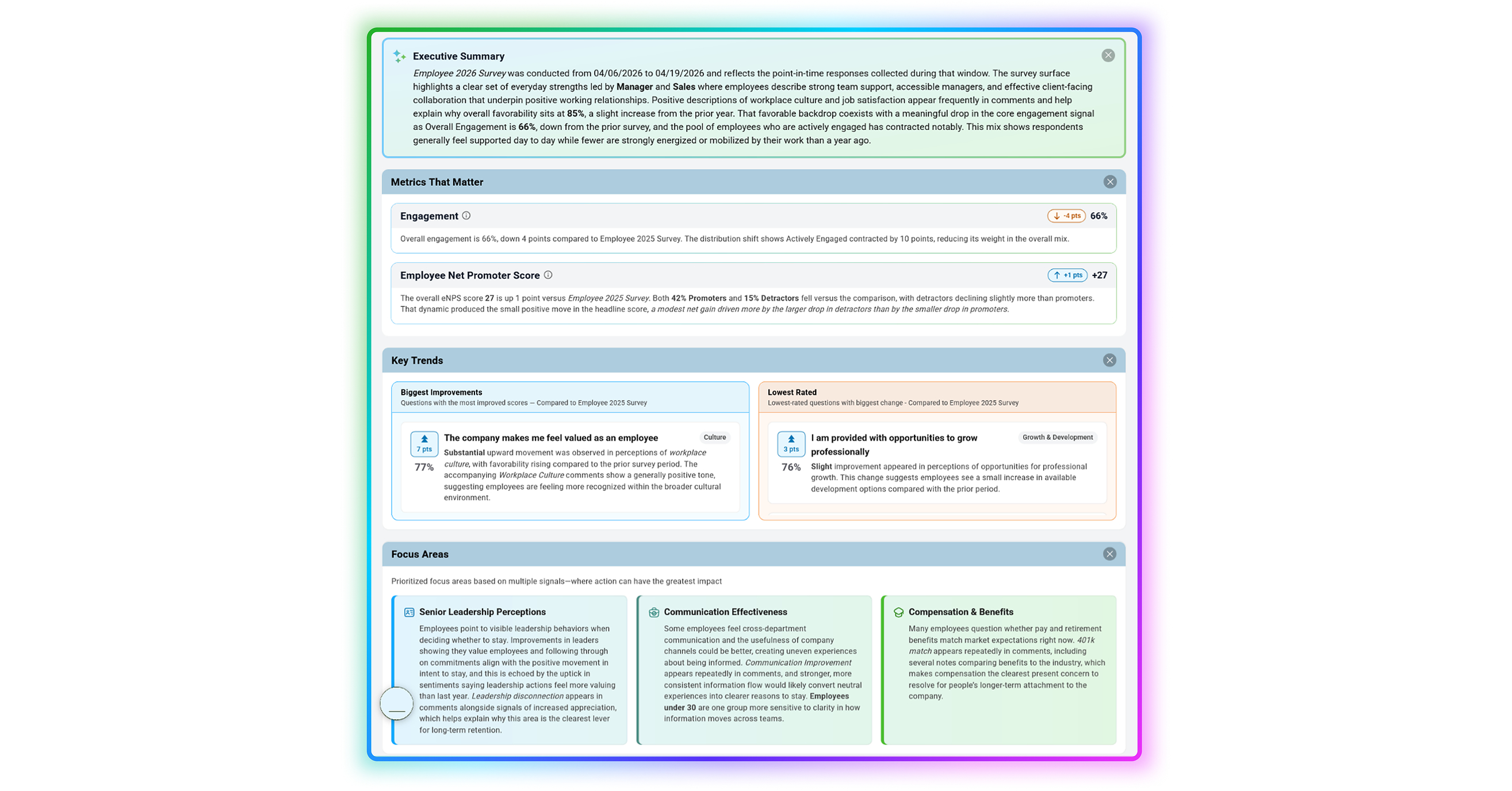
People Element launched “Analyst Insight,” a built-in AI analyst that automatically surfaces key trends and priorities from employee feedback without requiring prompts or manual analysis. The company says the tool connects employee comments, survey results, and organizational trends into action-ready next steps to speed workforce decision-making. As an HR software product update, it’s likely to be more incremental than market-moving, with modest positive sentiment around enhanced product capabilities.
This reads as a retention-defense feature, not a new growth vector. In HR software, “AI insights” usually monetize first through churn reduction and faster sales cycles, while true ARR expansion depends on whether buyers pay extra for automation versus treating it as table-stakes. The second-order effect is that feature parity accelerates in point solutions: once a workflow can be summarized automatically, distribution and integrated data become the real moat, which favors suite vendors with payroll/HRIS adjacency more than standalone feedback tools.
Near term, the market should mostly ignore this unless management can prove three things over the next 1-2 quarters: higher attach rates, lower churn, or a premium pricing tier. Without that, this is a marketing wrapper around existing data exhaust. If adoption is strong, the beneficiaries are the incumbents that already own employee records and workflow context—ADP, PAYX, WDAY—because they can bundle insight into a broader stack at near-zero incremental CAC.
The contrarian risk is that the consensus overestimates AI willingness-to-pay in mid-market HR. Buyers are conservative on privacy and explainability, and automated sentiment analysis can create liability if managers act on noisy outputs. That makes the most likely 6-18 month outcome modestly positive for platform stickiness, but negative for pricing power across niche survey vendors. No direct trade in ESI itself; this is more a relative-value signal than a standalone catalyst.
AI-powered research, real-time alerts, and portfolio analytics for institutional investors.
Overall Sentiment
mildly positive
Sentiment Score
0.15
Ticker Sentiment
