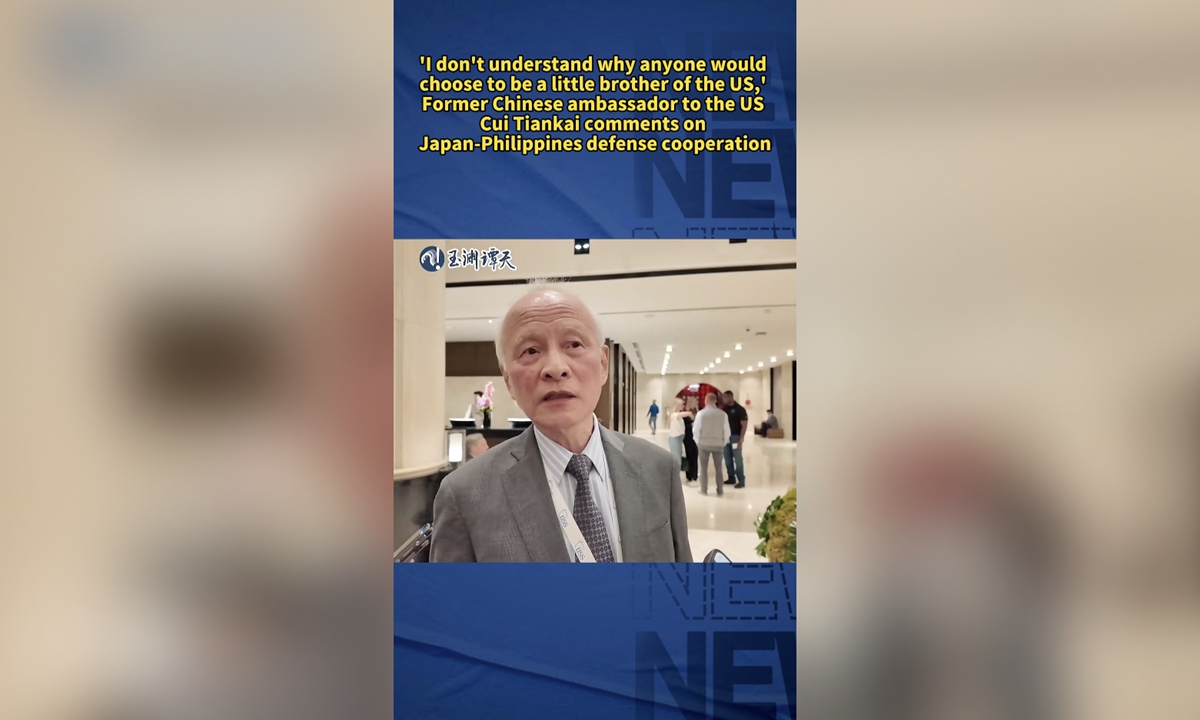
Former Chinese ambassador Cui Tiankai criticized Japan-Philippines defense cooperation at the Shangri-La Dialogue, framing it as undesirable alignment with the US. The article is primarily geopolitical commentary with no direct economic figures or corporate implications. Market impact is limited and likely confined to defense and Asia-related risk sentiment.
This is less about a single bilateral comment and more about Beijing testing the cohesion of the U.S.-aligned security lattice in the Western Pacific. The second-order effect is that Japan, the Philippines, and other regional partners have more incentive to accelerate interoperability, because public Chinese signaling like this increases the perceived value of redundancy and collective deterrence. That dynamic benefits defense primes, maritime surveillance, electronic warfare, and munitions suppliers more than headline naval shipbuilders, because the near-term spend is likely to be on sensors, command-and-control, ISR, and stockpiles rather than large platform procurement.
The key risk is not an immediate kinetic escalation; it is a gradual but persistent ratchet in defense budgets and access agreements over the next 6-24 months. If Japan or the Philippines responds with more explicit basing, joint patrols, or missile-defense integration, the market will likely reprice regional defense names and logistics/infrastructure exposures tied to hardening supply chains, ports, and distributed fuel storage. Conversely, if Washington signals fatigue or reduces visible commitment, the implied premium in allied defense spending could unwind quickly, especially in names trading on geopolitical optionality rather than current earnings.
The contrarian read is that the rhetoric may actually be a positive for regional asset prices that depend on security clarity. Markets often underappreciate how much capex gets pulled forward when uncertainty becomes too noisy to ignore; this can accelerate procurement cycles and raise the long-run floor for defense revenue growth in Japan, South Korea, and Australia. The bigger underdiscussed effect is on infrastructure resilience: dispersed depots, anti-drone systems, undersea cable protection, and dual-use logistics become budget priorities, creating a broader trade than just pure defense.
AI-powered research, real-time alerts, and portfolio analytics for institutional investors.
Request TrialOverall Sentiment
neutral
Sentiment Score
-0.05
