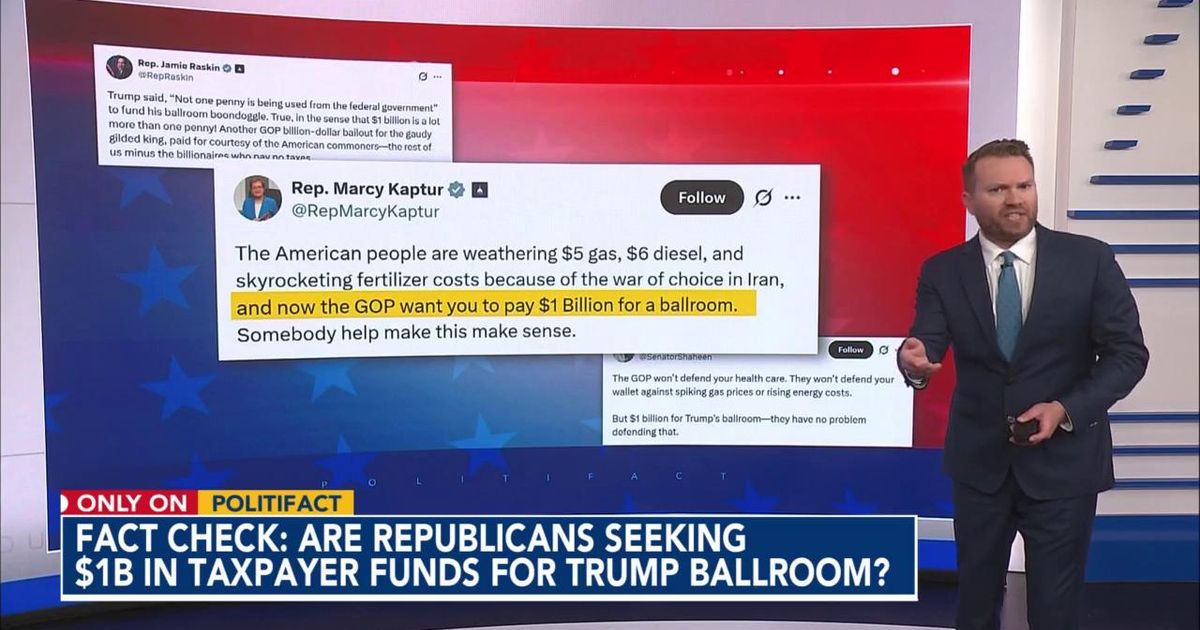
Senate Republicans have proposed legislation to authorize up to $1 billion in federal funding for security-related components of the White House East Wing modernization project, which includes Trump’s planned ballroom. The bill says taxpayer money cannot be used for non-security elements, but experts say the distinction may be difficult to enforce, leaving open the possibility that security features could subsidize ballroom construction. The article is primarily a political and budgetary dispute with limited direct market impact.
The market relevance is not the ballroom itself; it is the precedent that a politically sensitive, quasi-discretionary federal build can be reclassified as security infrastructure. That creates a template for future “mission-critical” spending that is easier to pass under reconciliation and harder to ring-fence in practice, which is incrementally favorable for government contractors with federal security, engineering, and classified-facility exposure. The second-order winner is not Big Tech per se, but any vendor with compliant materials, secure communications, surveillance, or hardened construction capabilities that can sit inside a multi-year procurement cycle.
The near-term catalyst risk is procedural: if the bill advances, the real trade will be in contractors and suppliers with lobbying reach, not in headline politics. Over 1-3 months, the key is whether congressional oversight imposes line-item constraints; absent that, cost creep is the base case because security scope is inherently expandable and easy to justify after the fact. That argues for treating the project as a call option on federal security appropriations, with the upside concentrated in firms that can monetize change orders and the downside limited by already-large federal backlogs.
The contrarian view is that the market may overestimate immediate fiscal leakage and underestimate legal delay. If courts or appropriators force tighter definitions of “security,” the dollars could be stranded or pushed into a slower procurement timetable, muting any benefit to contractors. For AMZN, GOOGL, META, and MSFT specifically, the direct read-through is negligible, but the broader implication is reputational and regulatory: major corporate donors tied to the project may face episodic scrutiny, though that is more a headline risk than a balance-sheet risk.
AI-powered research, real-time alerts, and portfolio analytics for institutional investors.
Request DemoOverall Sentiment
neutral
Sentiment Score
-0.05
Ticker Sentiment
