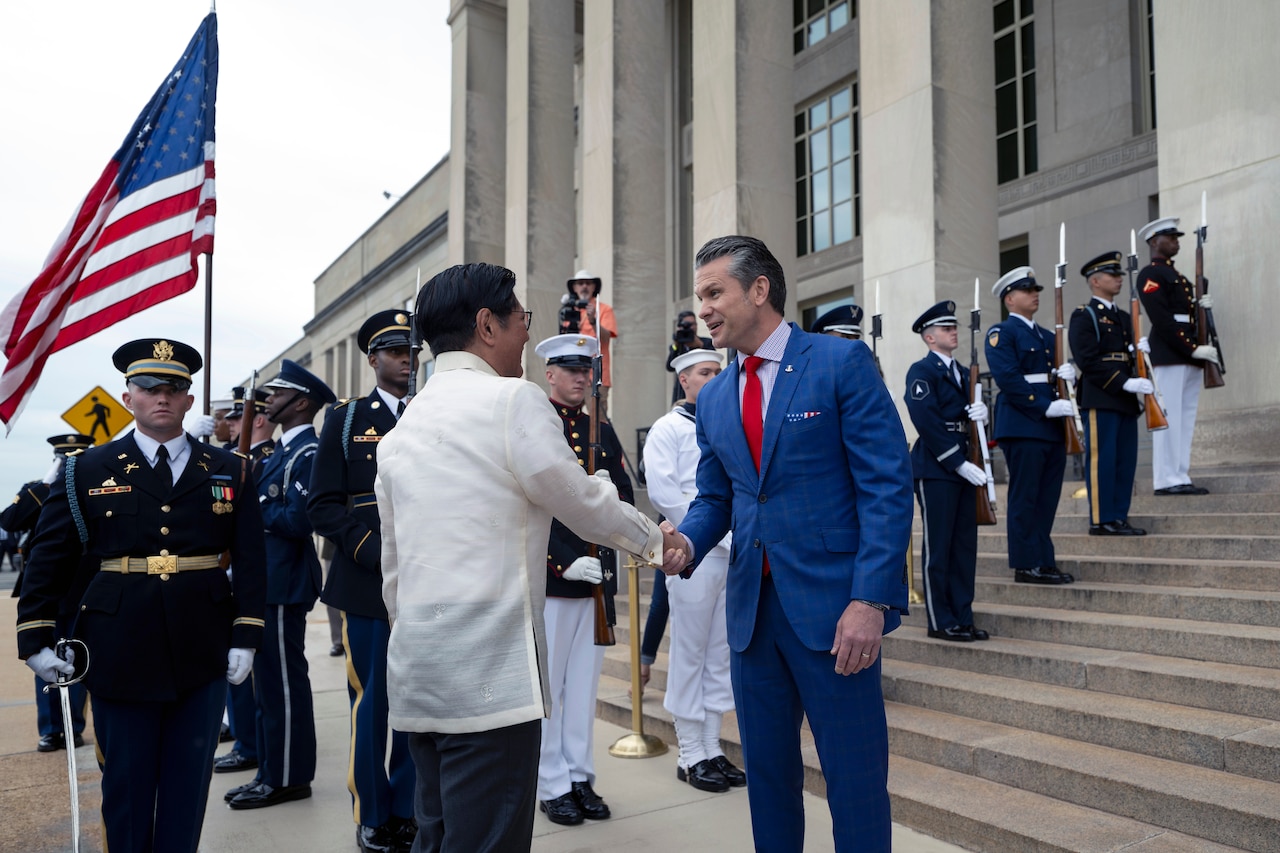
U.S. Defense Secretary Pete Hegseth and Philippine President Ferdinand Marcos Jr. reaffirmed their mutual defense treaty, explicitly extending its coverage to the South China Sea and underscoring a strengthened alliance aimed at regional deterrence. This commitment is backed by significant military modernization efforts, including the successful Balikatan 2025 exercise involving over 20 nations, and plans to deploy cutting-edge missiles and unmanned systems, signaling a robust posture to ensure Indo-Pacific stability.
The United States and the Philippines have significantly reinforced their strategic alliance, with the U.S. explicitly extending its Mutual Defense Treaty to cover armed attacks on Philippine assets, including Coast Guard vessels, within the South China Sea. This formal declaration elevates the strategic importance of the partnership and serves as a key pillar in the U.S. agenda of projecting "peace through strength" in the Asia-Pacific, its designated priority theater. The commitment is substantiated by tangible military cooperation, including the recent large-scale Balikatan 2025 exercise involving over 14,000 personnel, which enhanced interoperability across air, land, sea, cyber, and space domains. Critically for the defense sector, the alliance's modernization efforts are focused on deploying "new cutting-edge missiles and ... unmanned systems" and revitalizing defense industrial bases. While the direct market impact is assessed as low, these developments signal a sustained, long-term demand for advanced defense technology and a heightened geopolitical focus on the region, underpinning a durable investment theme in specific defense sub-sectors.
AI-powered research, real-time alerts, and portfolio analytics for institutional investors.
Request DemoOverall Sentiment
strongly positive
Sentiment Score
0.80
