

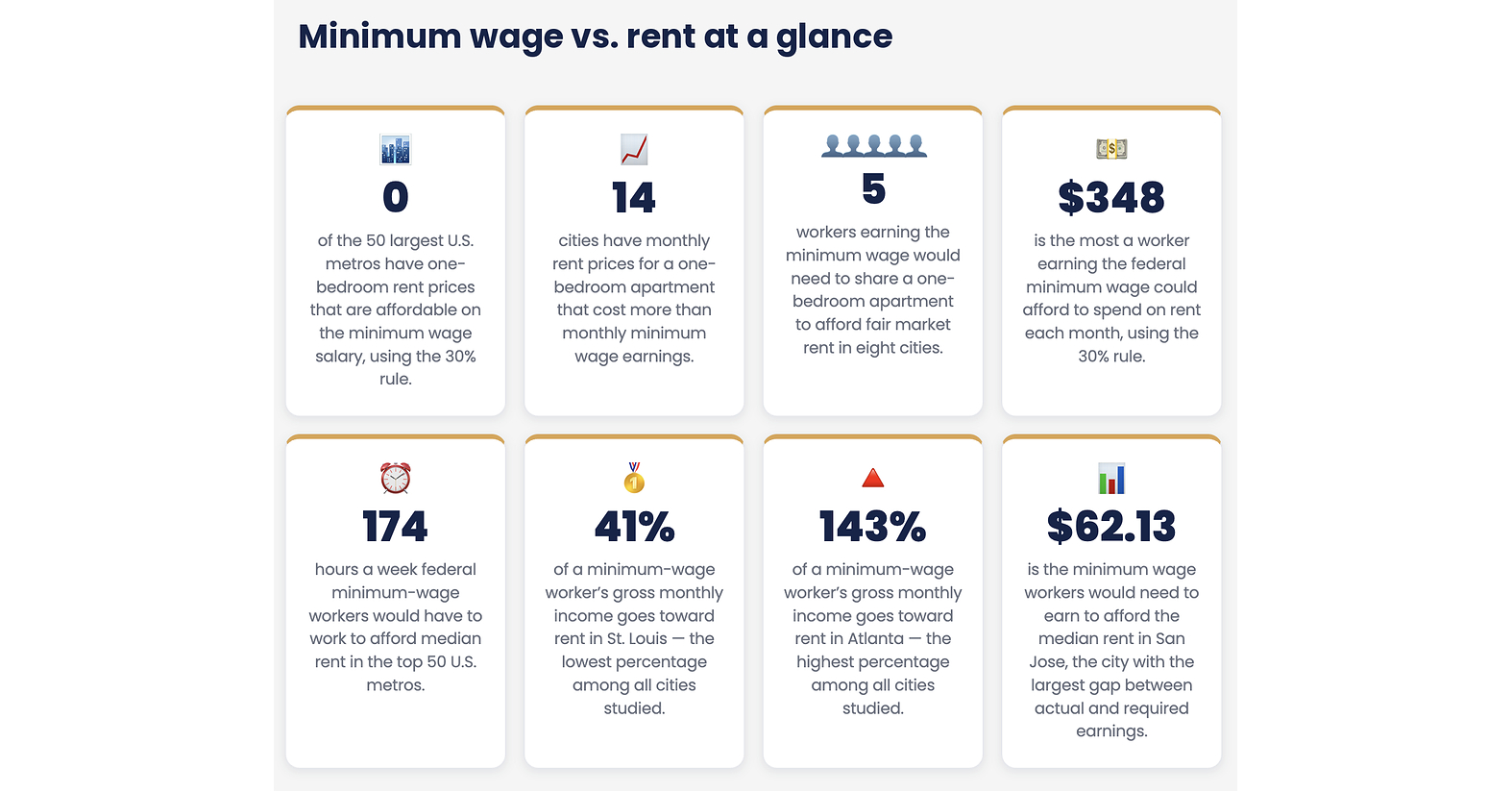
A new report finds that in all 50 largest U.S. metros, a minimum-wage worker cannot comfortably afford a one-bedroom under the 30% housing rule (by 2026 standards). In 14 metros, the typical monthly one-bedroom rent costs more than a minimum-wage worker earns in an entire month, while in 12 metros four workers would need to share to meet the 30% threshold. Atlanta is the least affordable (rent at 143% of gross monthly income, about $500 short), and only St. Louis, Kansas City, and Detroit would become affordable if minimum wage rose by $10/hour.
This is not an earnings catalyst for CLVR/TSTS; it is a macro affordability data point that mainly matters through policy and housing-demand channels. The near-term market mechanism is not “rents go down” but “mix changes”: more roommateing, more move-outs from high-cost metros, and a bigger share of households pushed into smaller units or farther-out submarkets. That tends to support occupancy for lower- and mid-tier rental stock while capping rent growth for premium urban apartments and increasing political pressure on landlords.
The cleaner equity read-through is to entry-level housing exposure: homebuilders, mortgage originators, and rate-sensitive housing ETFs (XHB, ITB, RKT, UWMC) face a demand ceiling because the first-time buyer funnel is already structurally broken. The second-order effect is that housing stress often delays household formation rather than eliminating it, which can be mildly supportive for multifamily occupancy over 1-3 months, but only until affordability fatigue triggers a demand trade-down into shared housing. That makes the likely outcome slower revenue growth, not a clean occupancy collapse.
The contrarian point is that the consensus may overstate this as a bearish housing signal. If wages remain sticky and rents keep outrunning income, the more immediate beneficiaries are suburban single-family rentals (AMH, INVH) and discounted formats, not luxury apartment landlords. The real tail risk is regulatory: if local elections convert affordability anger into rent caps, eviction limits, or fee restrictions, the repricing for apartment REITs could be months away but sharp. Falsifier: a sustained re-acceleration in wage growth, or a meaningful rent-downturn in the next 2 CPI shelter prints, would weaken the housing-short thesis materially.
AI-powered research, real-time alerts, and portfolio analytics for institutional investors.
Request TrialOverall Sentiment
mildly negative
Sentiment Score
-0.35
Ticker Sentiment
