
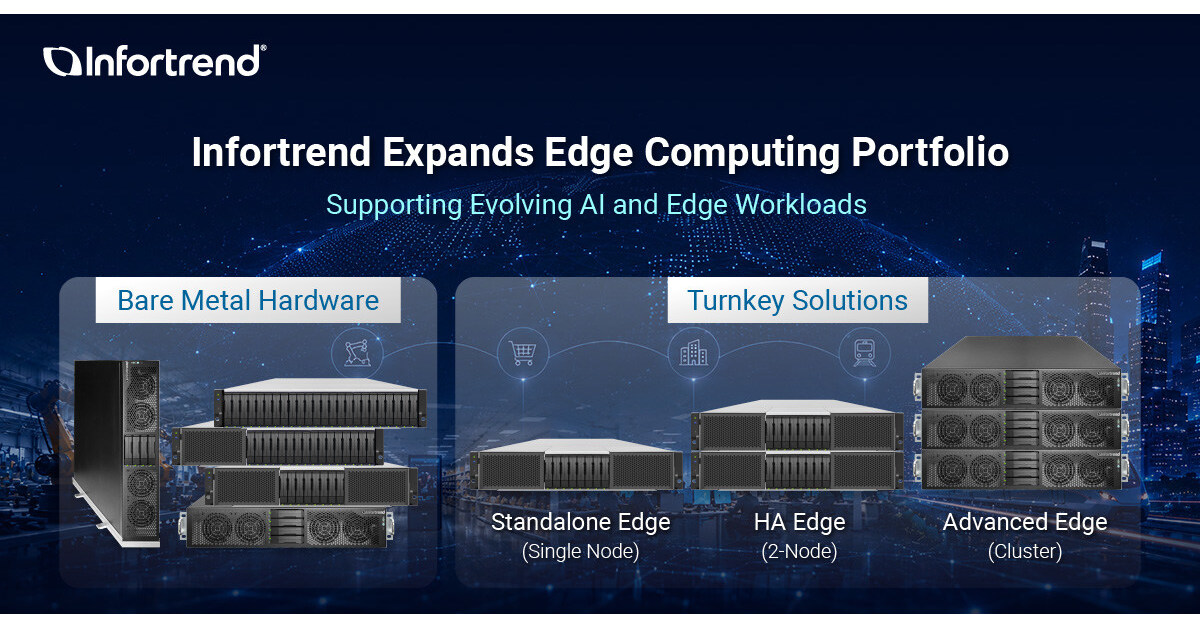
Infortrend (TWSE:2495) erweitert sein Edge-Computing-Portfolio, um Edge-KI-Inferenz sowie Virtualisierung und containerisierte Anwendungen von Einzelknoten bis zu hochverfügbaren 2-Node/3–5-Node-Clustern abzudecken. Die Hardware-Baureihen KS 3000U (1× AMD EPYC 8004, bis zu 2 GPUs) und KS 5000U (bis zu 320 CPU-Kerne, bis zu 4 GPUs; Intel Xeon oder AMD EPYC 9004/9005) sollen unterschiedliche Platz-, Latenz- und Skalierungsanforderungen adressieren. Die Ankündigung ist produkt-/capability-getrieben und dürfte eher begrenzten, aber positiven Einfluss auf die Wahrnehmung im KI-Infrastruktur-Umfeld haben.
This is directionally supportive for AMD only at the margins: it reinforces that the incremental AI buildout is not just hyperscale GPUs, but a growing layer of distributed inference nodes where CPU density, power efficiency, and platform flexibility matter. If edge AI adoption broadens from pilots to fleets, AMD’s EPYC socket share can rise in mixed workloads even when GPU attach rates stay modest, which is a better path to durable server CPU content than chasing headline AI accelerator wins.
The bigger market implication is competitive, not company-specific: edge deployments tend to be more fragmented and price-sensitive than cloud AI, which favors vendors that can package validation, thermals, and software into turnkey appliances. That is structurally positive for integrated server/solution providers and modestly negative for pure-play cloud-inference narratives, because some inference spend migrates away from centralized clusters into localized inference boxes with lower networking and cloud-service intensity.
The contrarian view is that this remains a brochure-level signal, not a demand inflection. Edge AI still faces deployment friction: site-level IT scarcity, software orchestration complexity, and slow refresh cycles, so the first meaningful revenue read-through is months away and may never show up in a visible line item for AMD unless OEM channel commentary confirms higher EPYC mix in compact and HA systems. Falsifier: if AMD’s data-center CPU revenue or server share fails to improve over the next 2-3 quarters despite continued edge-AI rhetoric, this thesis is just narrative spillover rather than earnings power.
AI-powered research, real-time alerts, and portfolio analytics for institutional investors.
Request TrialOverall Sentiment
mildly positive
Sentiment Score
0.18
Ticker Sentiment
