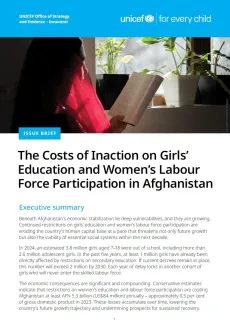
Afghanistan is losing at least AFN 5.3 billion, or about US$84 million annually, from restrictions on women’s education and labour force participation, equal to roughly 0.5% of 2023 GDP. The brief warns that 3.8 million girls were out of school in 2024, including more than 2.6 million adolescents, and that the human-capital drag could worsen shortages in health and education. While the story is macro-relevant, it is primarily a policy and development risk rather than a near-term market driver.
This is not just a social-policy negative; it is a slow-burn balance-sheet problem. The immediate macro drag is small in GDP terms, but the compounding damage comes from a shrinking pipeline of skilled female workers, which lowers the economy’s effective labor supply, tax base, and institutional capacity simultaneously. That combination tends to show up first as weaker service delivery, then as higher informalization and lower productivity, which are harder to reverse than a cyclical downturn.
The second-order implication is a deterioration in human-capital intensive sectors relative to commodity-linked or security-linked activity. Education, healthcare, telecom, and formal consumer services become increasingly constrained by staffing shortages and lower household income elasticity, while remittance dependence and informal trade likely gain share. Over a 2-5 year horizon, the main macro risk is not just lower growth but a less fungible state: fewer qualified teachers, nurses, administrators, and mid-level managers means policy transmission weakens even if external financing improves.
The market is likely underpricing the duration risk here. Consensus often treats these issues as reputational or sanctions-related headlines, but the more durable effect is on labor quality and household formation, which suppresses long-run domestic demand and increases instability premia. A reversal would require credible policy change, but absent that, the base case is gradual erosion rather than discrete collapse, which means the best expression is via assets sensitive to multi-year human-capital decay rather than headline event risk.
AI-powered research, real-time alerts, and portfolio analytics for institutional investors.
Request DemoOverall Sentiment
moderately negative
Sentiment Score
-0.45
