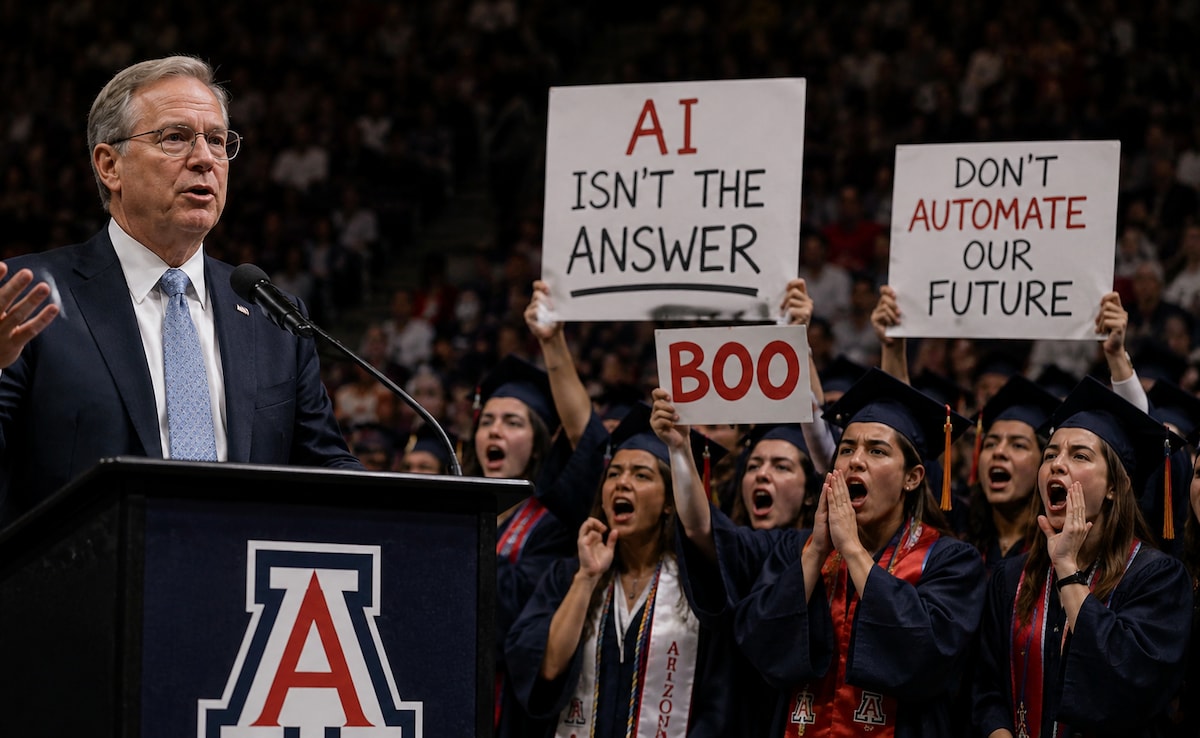
University of Arizona graduates booed former Google CEO Eric Schmidt for repeatedly mentioning AI in his commencement speech, highlighting growing student anxiety about AI's impact on entry-level jobs, creativity, and long-term career stability. The article frames a widening trust gap: AI is seen as inevitable, but not necessarily welcomed, especially when communicated as a threat to future careers. The piece is sentiment-driven rather than market-moving and is unlikely to have direct price impact.
The market implication is not that AI adoption is slowing; it is that the social license around AI is deteriorating faster than the capital cycle. That matters because the next leg of AI monetization depends less on model capability and more on distribution, procurement, and political tolerance for labor displacement. In the near term, this is a sentiment headwind for the large-cap platform names with the most visible AI narratives, but it is structurally more relevant for software, media, and outsourcing businesses where buyers can delay spend if AI becomes associated with job cuts rather than productivity.
Second-order effects favor the picks-and-shovels layer over the consumer-facing evangelists. If end users resist “AI-first” messaging, enterprises will still buy infrastructure, but they will shift spend toward less controversial use cases: internal copilots, compliance, security, workflow automation, and private deployment. That tends to benefit semiconductor, data center, and enterprise infrastructure suppliers more than application-layer vendors whose ROI is easier to challenge in procurement committees.
The bigger risk is regulatory and labor backlash over a 6-18 month horizon, not an immediate demand collapse. If the political narrative hardens around AI as an entry-level job destroyer, we should expect tighter disclosure requirements, hiring frictions, and slower adoption in education, government, media, and customer support. The contrarian read is that public discomfort may actually extend the runway for incumbents like GOOGL: as trust declines, buyers may prefer “safer” AI integrated into existing workflows rather than standalone AI challengers, preserving platform share even if headline enthusiasm fades.
For GOOGL specifically, this is a modest sentiment overhang rather than a fundamental thesis break. The stock is more exposed to narrative risk than to revenue risk, and that typically creates a shorter-lived multiple discount than a durable earnings downgrade. The selloff risk is highest when AI messaging is tied to labor headlines, but the reversal catalyst is straightforward: visible enterprise monetization with low displacement optics.
AI-powered research, real-time alerts, and portfolio analytics for institutional investors.
Request DemoOverall Sentiment
mildly negative
Sentiment Score
-0.20
Ticker Sentiment
