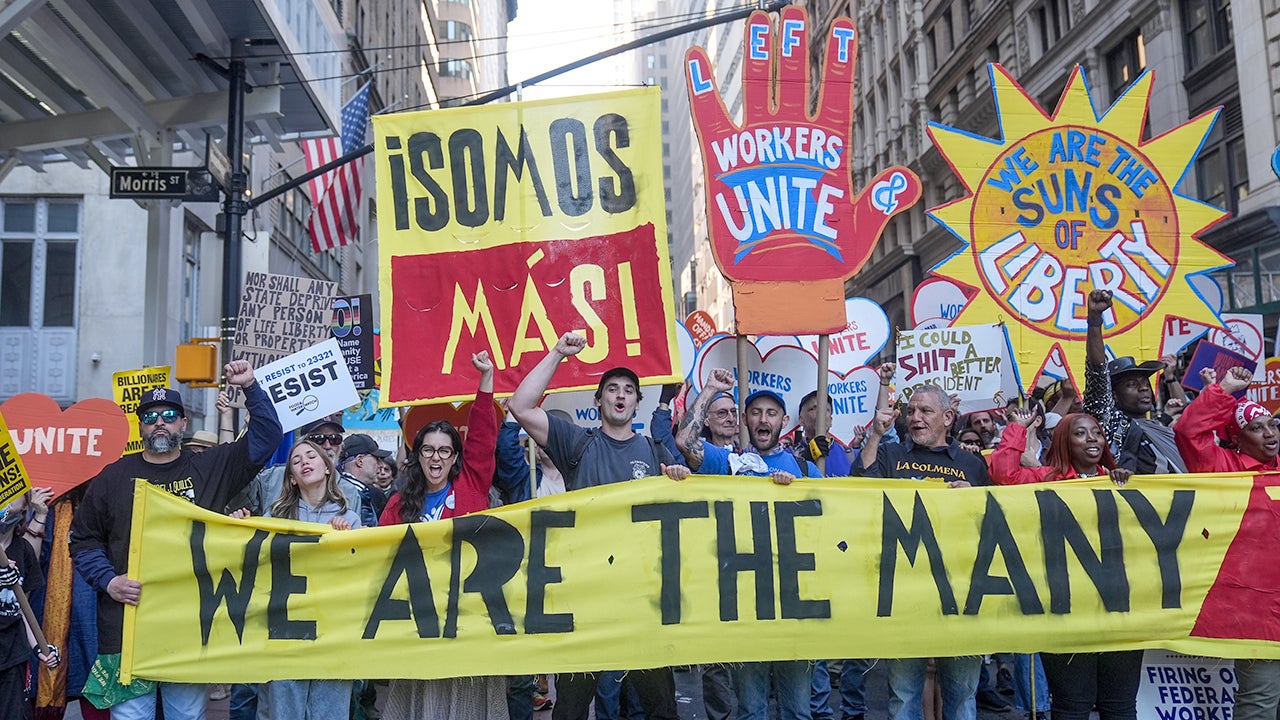
The article centers on nationwide May Day protests involving roughly 600 groups and an estimated 3,000-6,000 events, with demonstrations focused on anti-Trump, anti-ICE, labor, and pro-immigration themes. It highlights participation from labor unions, socialist organizations, and activist networks, along with scattered arrests and clashes in New York and abroad. The piece is primarily political and activist coverage rather than direct market-moving news, so near-term financial impact appears limited.
The immediate market read-through is less about the demonstrations themselves and more about the coordination signal: labor, campus, nonprofit, and activist networks are acting with enough discipline to create localized disruption risk, but not enough cohesion to create a durable macro shock. That argues for tactical volatility in the most visible protest targets — large consumer-facing, logistics-heavy, and “symbolic” corporates — while the broader market likely shrugs unless the events spill into work stoppages, transit bottlenecks, or school closures that persist beyond a single day.
AMZN is the cleanest public-market proxy because it sits at the intersection of labor activism, anti-automation rhetoric, and supply-chain optics. The direct earnings risk is minimal, but the reputational overhang can matter around peak demand windows: labor narratives tend to amplify union organizing, wage pressure, and local permit friction more than they hit quarterly numbers. A more interesting second-order effect is that activist attention can slow warehouse throughput or raise overtime expense at the margin, which becomes relevant if this escalates from one-off protest theater into a recurring organizing template.
The bigger contrarian point is that this is not automatically bearish for every politically adjacent asset. Heightened anti-ICE / anti-border rhetoric increases the odds of a harder line on immigration and labor enforcement becoming a central election issue, which can reprice municipal services, staffing, security, and private detention-adjacent spend over a multi-month horizon. The consensus may be overstating the near-term market impact of the protests while understating the probability that labor scarcity and political polarization keep wage inflation sticky in selected service sectors.
The tail risk is a disorderly escalation: if protests start chaining into downtown commerce, transit, or campus shutdowns, the market will quickly move from ‘headline noise’ to ‘operational friction.’ In that case, the first beneficiaries are not ideological names but high-quality service substitutes and security/monitoring vendors, while the losers are consumer-discretionary and logistics operators with high urban exposure. For now, this looks like a sentiment event with an options-friendly skew, not a fundamental regime change.
AI-powered research, real-time alerts, and portfolio analytics for institutional investors.
Request DemoOverall Sentiment
neutral
Sentiment Score
-0.10
Ticker Sentiment
