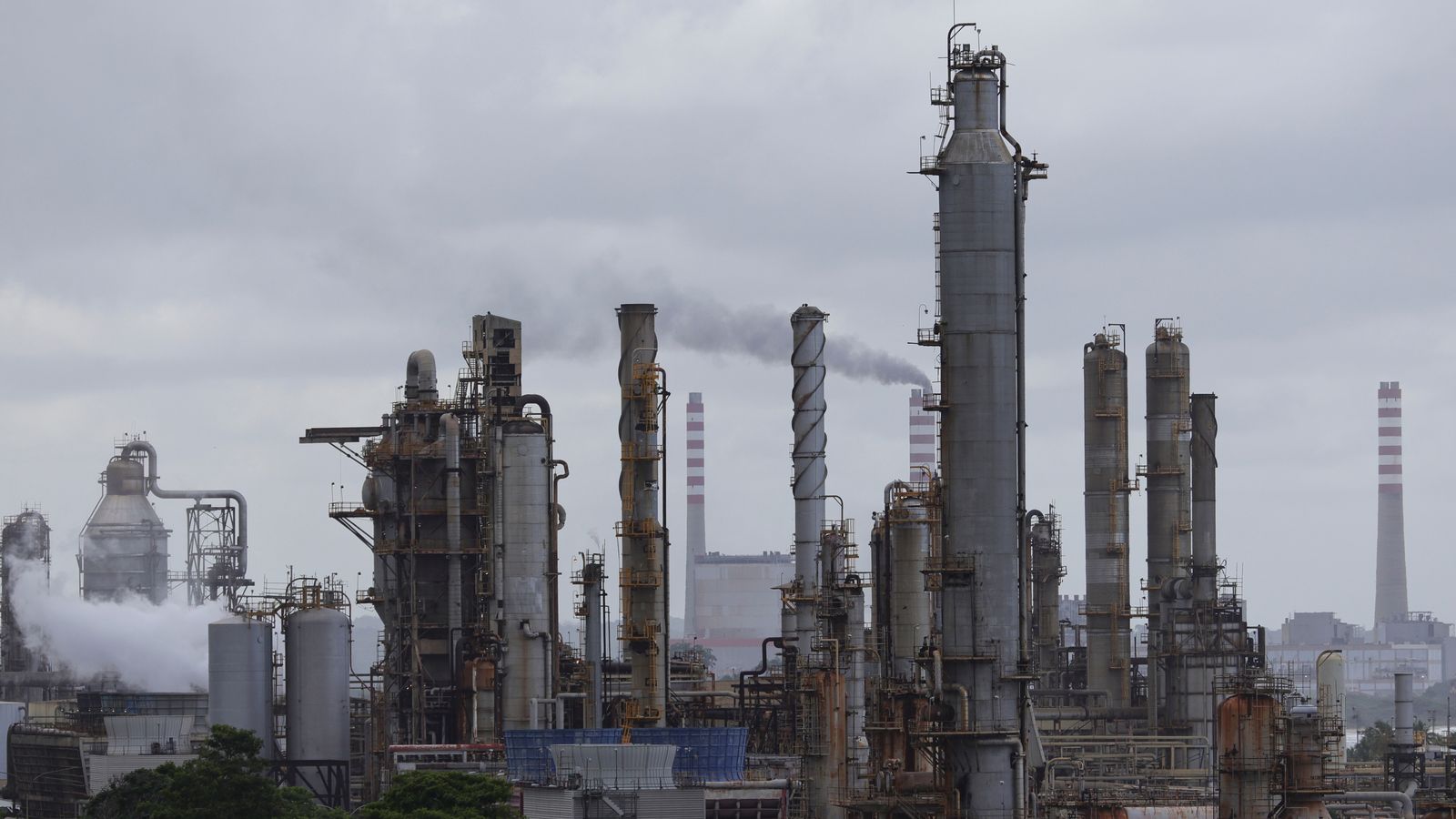
Venezuela holds roughly 17% of global proven oil reserves (about 303 billion barrels) but production has collapsed from ~3.5 million bpd in the 1970s to ~1.1 million bpd last year amid sanctions, corruption and underinvestment. With U.S. sanctions currently prohibiting Venezuelan exports and most heavy‑oil infrastructure degraded, President Trump’s statement that the U.S. would “run” Venezuela to tap its heavy Orinoco reserves raises geopolitical risk and long‑term supply implications; analysts estimate tens of billions of dollars would be needed to rehabilitate output, and only Chevron currently operates among U.S. majors. Investors should weigh the potential upside of unlocking large heavy‑oil resources against near‑term legal, operational and sanction constraints that make any production rebound uncertain and multi‑year.
Market structure: Short-term winners are geopolitically connected US oil majors with existing Venezuelan footprints (Chevron/CVX) and heavy-crude processors in the USGC; losers are non-participating majors and Venezuela bondholders. Restoring Venezuela’s ~1.1 mb/d (current) toward past peaks would shift heavy-sour balances over years (not weeks) and compress heavy-light spreads; immediate price pressure is limited unless >300–500 kb/d returns quickly. Cross-asset: oil volatility will lift crude futures, widen Brent/WTI differentials, pressure EM sovereign credit (VEB/PDVSA), and nudge USD safe-haven flows in spikes.
Risk assessment: Tail risks include protracted insurgency, third-party intervention (Russia/China), or rapid re-nationalization — each could wipe out on-the-ground investments and re-instate sanctions; probability medium but impact severe. Timeline: days — volatility spikes; weeks–months — policy/statements re: sanctions and company guidance; years — capex-driven production recovery needing tens of billions and 2–5+ years to materially raise exports. Hidden dependencies: bank access, insurance, retooling refineries for heavy crude, and legal/regulatory clearance from OFAC.
Trade implications: Favor asymmetric optional exposure to CVX (operational presence) and volatility plays on crude—buy 3–6 month call spreads on Brent for upside >$10/bbl; execute a relative-value pair long CVX / short COP to capture licensing and political arbitrage over 3–9 months. Rotate modestly into oilfield services (SLB, BKR) and USGC refiners if credible sanctions relief occurs; size initial entries small (1–3% positions) and scale on confirmed policy moves.
Contrarian angles: Consensus overweights immediate supply upside; reality is production restoration is capital- and time-intensive — the market may be underpricing multi-year capex risk and sovereign/legal exposures. Historical parallels (Iraq/Kuwait) show political control doesn’t equal rapid export restart; unintended consequences include reputational/regulatory costs for US majors and longer-term price strength if restoration stalls. Look for mispricings where political headlines move stocks more than fundamentals.
AI-powered research, real-time alerts, and portfolio analytics for institutional investors.
Request DemoOverall Sentiment
mixed
Sentiment Score
0.00
Ticker Sentiment
