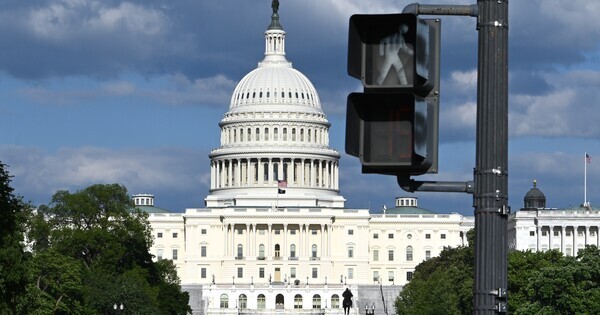
The U.S. House approved the Senate-passed funding bill to finance much of the Homeland Security Department, aimed at ending the record 75-day shutdown. The vote is a procedural step in resolving a budget standoff rather than a direct market catalyst, though it reduces near-term federal funding uncertainty. The article provides no financial figures, and the market impact is likely limited.
The immediate market impact is not the bill itself but the removal of a near-term governance overhang that has been freezing purchasing decisions, contracting, and operational approvals around DHS-adjacent vendors. Expect the first-order beneficiaries to be the boring but highly levered service providers that rely on steady federal disbursement—security staffing, facilities, screening equipment, IT integrators, and logistics firms with government exposure—because shutdowns create backlog that tends to convert into catch-up spend over the next 2-8 weeks. The larger second-order effect is political: once a funding patch is in place, agencies typically accelerate procurement to recover lost time, which can temporarily pull forward revenue recognition for contractors without changing full-year demand.
The more interesting trade is in names exposed to border, screening, and emergency-response capex rather than broad defense primes. A prolonged shutdown often causes missed maintenance and delayed inspections, which can create a small burst of replacement demand for equipment and software tied to identity verification, asset tracking, and critical infrastructure security. That said, the upside is likely transitory: if Congress has only bought time rather than solved the fiscal dispute, the same vendors face a higher probability of renewed headline risk in the next funding cycle, keeping multiples capped despite near-term relief.
Consensus is likely to underestimate the asymmetry between sentiment improvement and actual revenue improvement. A funding bill can lift the group on de-risking alone, but the real earnings effect depends on whether agencies get authority to re-obligate spent budgets and whether backlogged contracts survive the next appropriations round; if not, the move becomes a tape-driven bounce rather than a fundamental re-rate. The contrarian angle is that the cleanest opportunity may be in buying the laggards that were oversold on shutdown fears, while fading broad index proxies that will retrace quickly once the headline passes.
AI-powered research, real-time alerts, and portfolio analytics for institutional investors.
Request DemoOverall Sentiment
neutral
Sentiment Score
0.05
