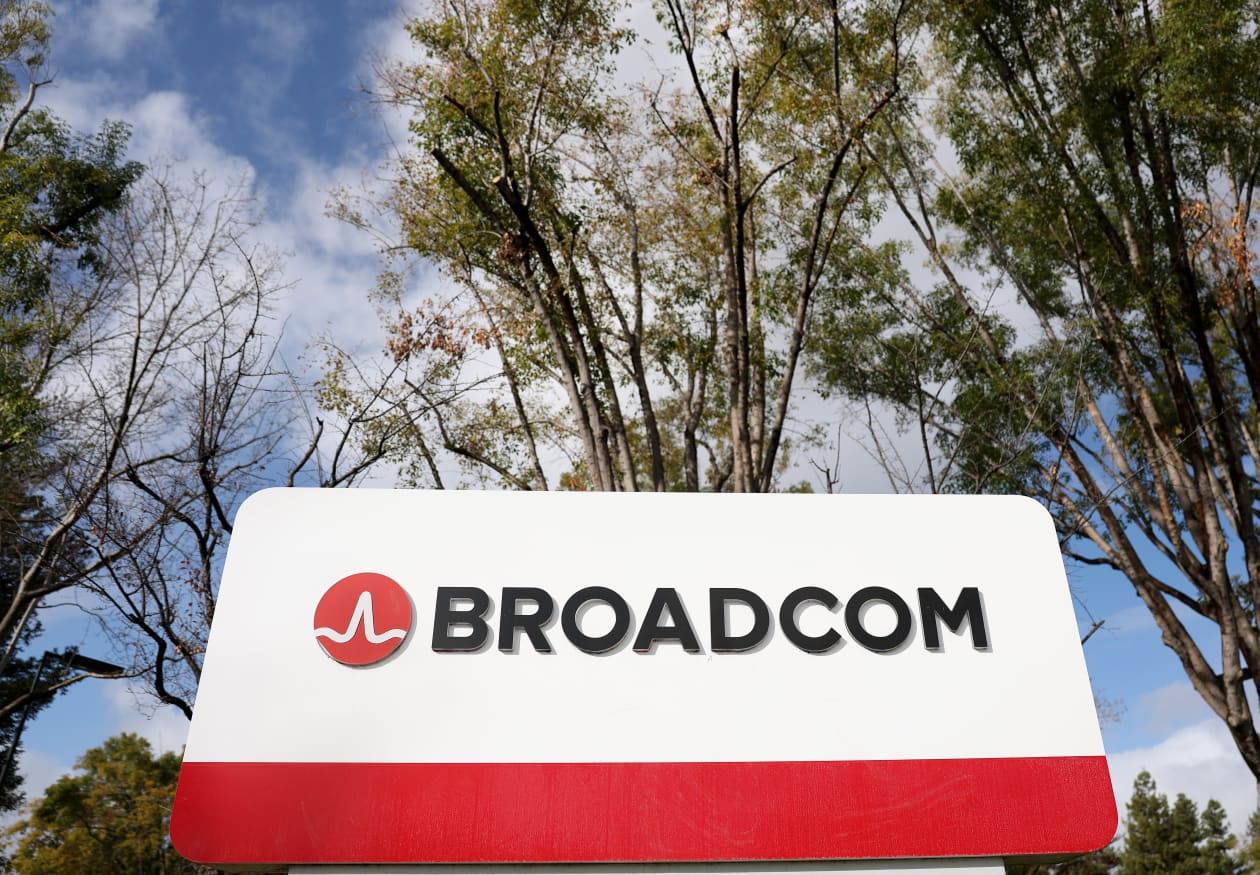
Broadcom’s market capitalization passed $2 trillion, making it only the sixth U.S. company to reach that milestone. The move was aided by strength in chip stocks and Google’s announcement of new TPUs, reinforcing AI-related demand for semiconductor hardware. The news is positively skewed for Broadcom and the broader chip sector, though it is more milestone-driven than fundamentally transformative.
AVGO’s move above the $2T mark is less about a single headline and more about the market pricing it as the cleanest non-NVDA AI monetization path. The important second-order effect is that investors are implicitly giving Broadcom quasi-platform multiples for custom silicon + networking + software, which raises the bar for every other “pick-and-shovel” AI infrastructure name to prove durable share, not just cyclical upside. That is supportive for the entire AI capex complex near term, but it also concentrates expectations: once a stock is capitalized at this size, incremental upside increasingly depends on proving that AI demand is broadening faster than hyperscaler capex discipline tightens.
The key competitive implication is for NVDA and the rest of the data-center supply chain. If custom TPU/ASIC adoption is accelerating, it does not necessarily mean less AI spend; it can mean the spend shifts from merchant accelerators toward custom silicon, high-speed networking, optical interconnect, and packaging. That is a relative tailwind for AVGO and networking adjacencies, but a potential multiple headwind for pure-play accelerator names if investors start extrapolating share loss rather than total workload growth. Over the next 1-3 months, the trade will likely be driven more by flow and index ownership than fundamentals, which makes the move self-reinforcing but also fragile if breadth narrows.
The contrarian risk is that the market may be overconfident in the durability of this AI beneficiary hierarchy. Hyperscalers have a history of compressing supplier economics once volumes are committed, and the more strategic the silicon becomes, the more likely customers push for pricing concessions, second-source options, or in-house substitution over a 12-24 month horizon. If AI infrastructure spend merely normalizes instead of reaccelerating, today’s premium could compress quickly because the name now trades like an essential platform rather than a cyclical semicap.
For us, the highest-conviction setup is relative rather than directional: own AVGO against a basket of AI hardware laggards that are most exposed to multiple compression if custom silicon share gains persist. The cleaner medium-term expression is to pair long AVGO with short a more pure merchant-accelerator proxy on any post-event strength, while keeping sizing modest because the stock is vulnerable to overcrowding and headline-driven gap risk. The opportunity is best harvested over weeks, not quarters, unless next earnings confirm that AI revenue mix is still accelerating faster than the market already discounts.
AI-powered research, real-time alerts, and portfolio analytics for institutional investors.
Request TrialOverall Sentiment
moderately positive
Sentiment Score
0.62
Ticker Sentiment
