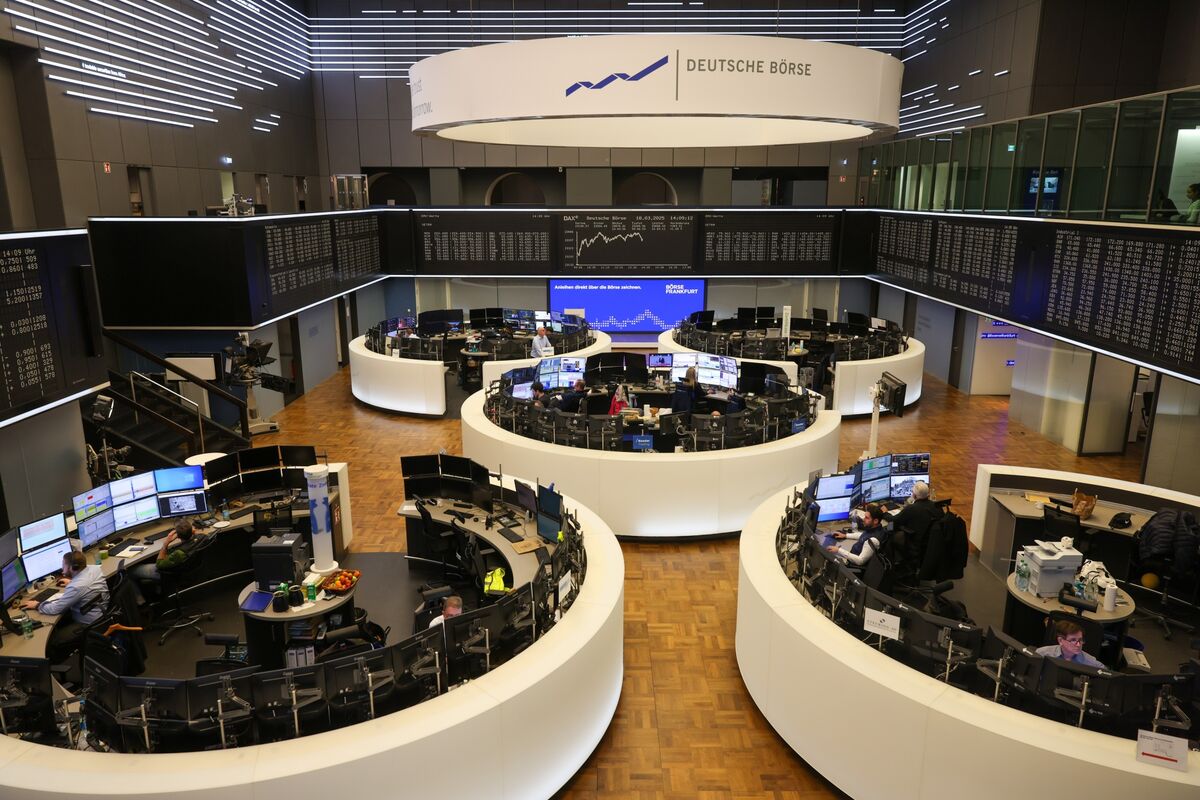
European IPO bankers report a pickup in activity driven by a strong crop of first-time offerings since September that are largely trading well, rising equity markets and a pipeline of large companies planning listings next year. Bankers say these factors underpin confidence that issuance will recover toward pre-pandemic levels by 2026, suggesting improving market breadth and investor appetite for new listings across Europe.
Market structure: Exchanges (ENX.PA, LSEG.L) and ECM desks at major banks (UBS, BARC.L) are best positioned to capture fee pools as issuance rebounds; expect fee revenue growth of 15-30% annualized in a scenario where issuance reaches ~70-100% of 2019 run-rate by 2026, while high-cost retail brokers and short-biased funds face squeezed alpha as new-issue supply and retail allocation rise. Increased primary supply improves market breadth but concentrates volatility in newly listed small caps, raising idiosyncratic dispersion and trading volumes that favor active market-makers and prime brokers (BNP.PA, MSFT? no). Cross-asset effects: reduced corporate bond issuance could modestly tighten credit spreads (-10–30bps) and support EUR versus safe-haven FX in risk-on windows; equity IV for IPO-heavy small caps will remain elevated 20–40% above large-cap IV in the 3 months post-listing.
Risk assessment: Key tail risks include a macro shock (2%-4% GDP contraction scenario) that collapses issuance, and regulatory clampdowns (ESMA/FCA tightening prospectus/advertising rules) within 30–90 days that can delay listings; both would quickly reverse sentiment. Short-term (days–weeks) risk is post-listing mean-reversion of 10–30% for frothy names; medium-term (quarters) depends on central bank policy—another 50–75bps of tightening would shorten risk appetite; long-term (2026) hinges on sustained retail/ETF demand and secondary liquidity. Hidden dependencies: margin lending availability, prime broker capacity, and retail distribution (platforms like Revolut/Trading212) drive realization of the pipeline.
Trade implications: Direct plays — establish 2–3% long positions in ENX.PA and LSEG.L over 4–8 weeks to capture fee re-rating; add 1% tactical long in UBS/ BARCLAYS (BARC.L) via 9-month call spreads to lever ECM upside with capped downside. Pair trade — go long ENX.PA (1.5%) vs short VGK (2%) to express structural exchange fee growth vs broad Europe; unwind if ENX outperforms VGK by >15% or IPO cadence misses guidance by >30%. Options — buy 3–6 month call spreads on ENX/LSEG to target 20–35% upside, and buy 3-month 5–10% OTM puts on VGK sized 0.5–1% portfolio as insurance.
Contrarian angles: Consensus overlooks quality variance — a pipeline weighted toward lower-margin or sector-concentrated listings (tech/crypto-adjacent) could produce durable underperformance despite headline volume growth; historical parallel: 2014–15 post-IPO mean reversion after a frothy window. The market may be underpricing the second-order effect that heavier primary issuance increases dispersion and reduces passive ETF flow efficiency, benefiting active managers and specialist funds but depressing passive returns. Unintended consequence: exchanges could face political/regulatory scrutiny if retail-favored IPOs lead to notable retail losses, triggering rule changes that compress future fee pools.
AI-powered research, real-time alerts, and portfolio analytics for institutional investors.
Request DemoOverall Sentiment
mildly positive
Sentiment Score
0.35
