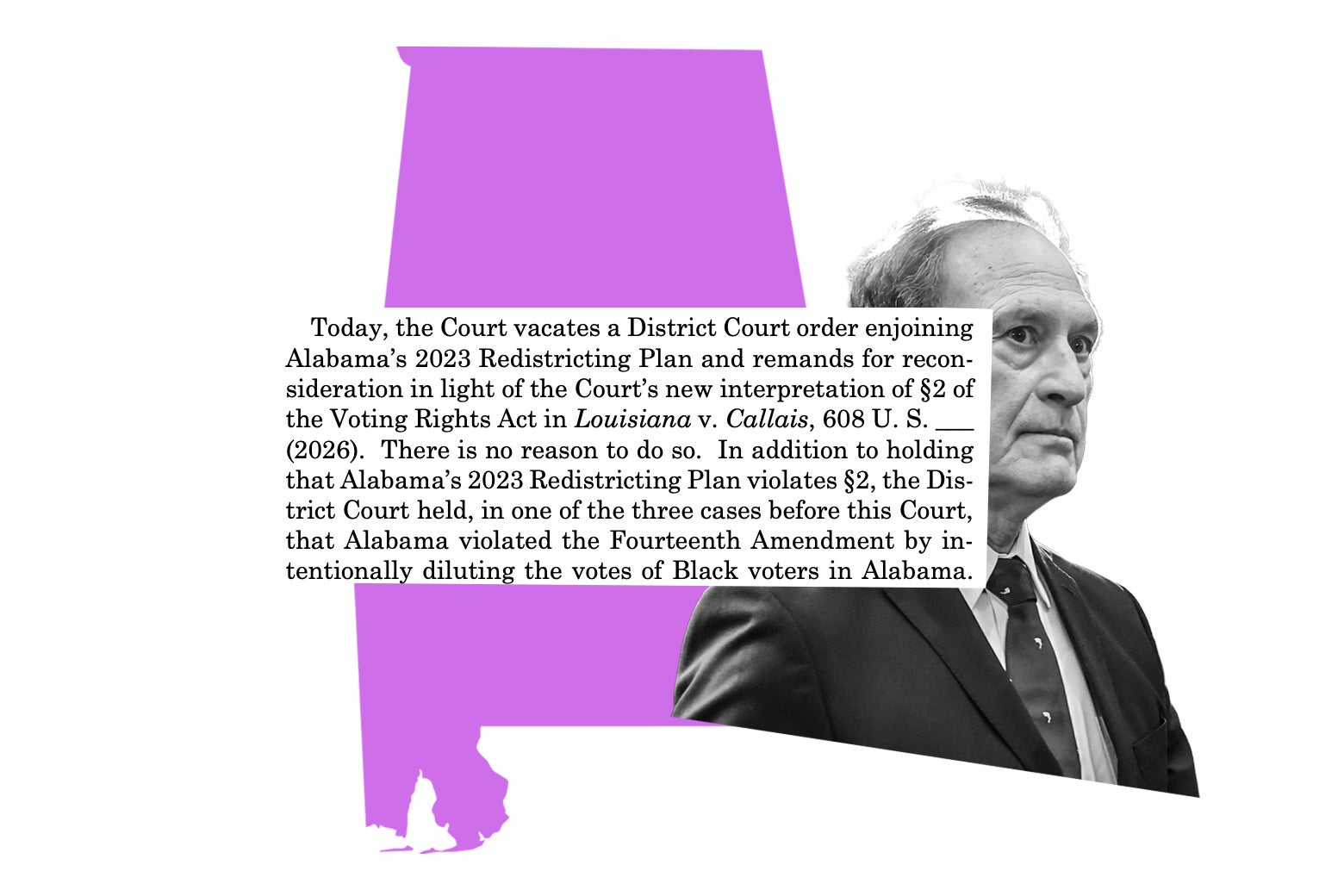
A federal court in Alabama again struck down the state's congressional map, finding intentional racial vote dilution and saying the gerrymander remained illegal even after the Supreme Court's Callais ruling. The decision keeps two Black opportunity districts in place for now and directly challenges Alabama's latest attempt to replace them with a racially discriminatory map. Alabama is appealing and seeking an emergency stay from SCOTUS, so the case could materially affect voting-rights jurisprudence and election administration.
The market implication is not a direct cash-flow read-through but a regime signal: when a lower court feels compelled to write this aggressively against the Supreme Court, the institutional error band around election-law enforcement is widening. That matters for any asset exposed to state-level policy implementation, because the bigger risk is not the headline ruling itself but a growing probability of last-minute administrative reversals, injunction whiplash, and uneven ballot-access enforcement across jurisdictions. In practice, that raises the value of legal optionality and lowers the reliability of any base case that assumes orderly state execution into November and beyond.
Second-order effects are likely to show up in volatility rather than direction. If Alabama gets emergency relief or if SCOTUS signals it will tolerate tactical gerrymanders under a weakened VRA, expect a broader repricing of red-state political risk: more litigation on district lines, voter-registration rules, and election administration, with increased sensitivity for companies with high exposure to municipal procurement, public-sector labor, or consumer geographies that map to contested districts. The more subtle effect is on governance credibility: repeated court defiance raises the odds that legislatures treat federal limits as negotiable, which can spill into other regulated domains and create a higher discount rate for policy-dependent earnings.
The contrarian read is that the most investable consequence may be the Supreme Court’s legitimacy premium, not voting rights per se. If the Court grants Alabama a stay after this record, it reinforces a pattern where emergency orders can override detailed factual findings, making late-cycle legal risk much harder to hedge and favoring defendants that can move quickly and exploit procedural delay. If, however, the Court denies relief, that would be an important signal that even a narrowing majority still sees a line against explicit race-based discrimination, which would dampen tail-risk pricing across the broader election-law complex over the next few weeks.
AI-powered research, real-time alerts, and portfolio analytics for institutional investors.
Request DemoOverall Sentiment
strongly negative
Sentiment Score
-0.70
