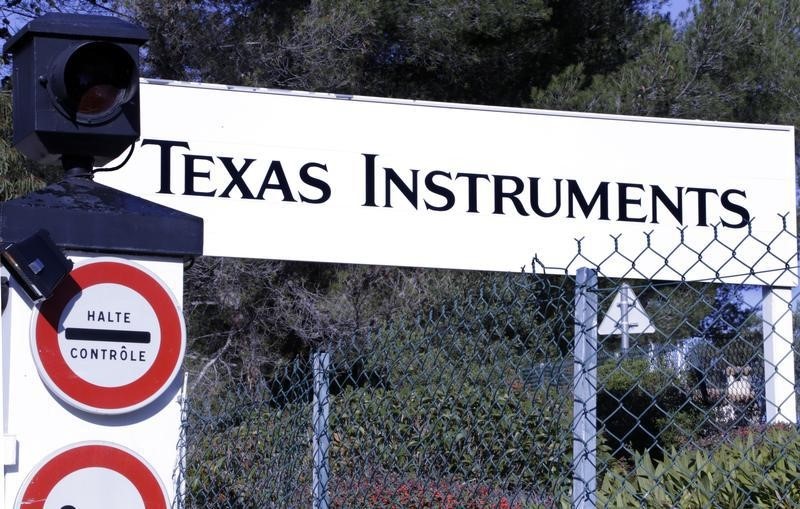
Cantor Fitzgerald raised its Texas Instruments price target to $300 from $280 while keeping a Neutral rating, citing pricing power and internal manufacturing strength. The note comes alongside a broader set of bullish analyst revisions after TXN’s Q1 results and Q2 guidance beat expectations, with revenue and EPS topping consensus by roughly $300M-$335M and $0.32-$0.34, respectively. Despite the constructive analyst backdrop, the stock at $304.10 is already up 72% YTD and near a 52-week high, limiting near-term upside.
TXN is being rewarded for a rare combination in semis: visible pricing power, captive manufacturing, and a demand mix that still skews toward industrial rather than the more headline-sensitive AI cycle. The second-order effect is that every incremental price increase drops disproportionately to operating leverage because the company controls more of the value chain than fab-light peers; that matters most if end-market recovery stays choppy, since margin expansion can continue even without a broad unit rebound.
The market, however, is already pricing in a fairly clean execution path. At these multiples, the stock is more vulnerable to any hint that the current pricing cycle is peaking or that customers are pushing back on late-cycle price actions, especially in automotive and industrial channels where procurement teams usually react with a lag of 1-2 quarters. If the expected July increase is smaller than expected or fails to broaden beyond a narrow product set, the narrative can shift quickly from “best-in-class manufacturing” to “peak margin optics.”
The bigger contrarian point is that TXN’s quality premium may be masking a slower fundamental inflection than the multiple implies. In a flat-to-modestly improving demand environment, the names with less self-help and lower starting expectations can outperform on revision momentum, while TXN’s upside becomes more capped because any incremental good news is already being capitalized into a near-growth valuation. That creates a setup where the stock can remain strong, but its relative return profile is less attractive than its absolute story suggests.
For competitors, TXN’s strength pressures other analog suppliers to defend share with either lower prices or heavier channel incentives, which can delay margin recovery across the group. That makes the next 1-2 quarters important not just for TXN, but as a read-through on whether industrial semiconductor pricing is inflecting broadly or just being managed tactically by the best-positioned player.
AI-powered research, real-time alerts, and portfolio analytics for institutional investors.
Request DemoOverall Sentiment
mildly positive
Sentiment Score
0.25
Ticker Sentiment
