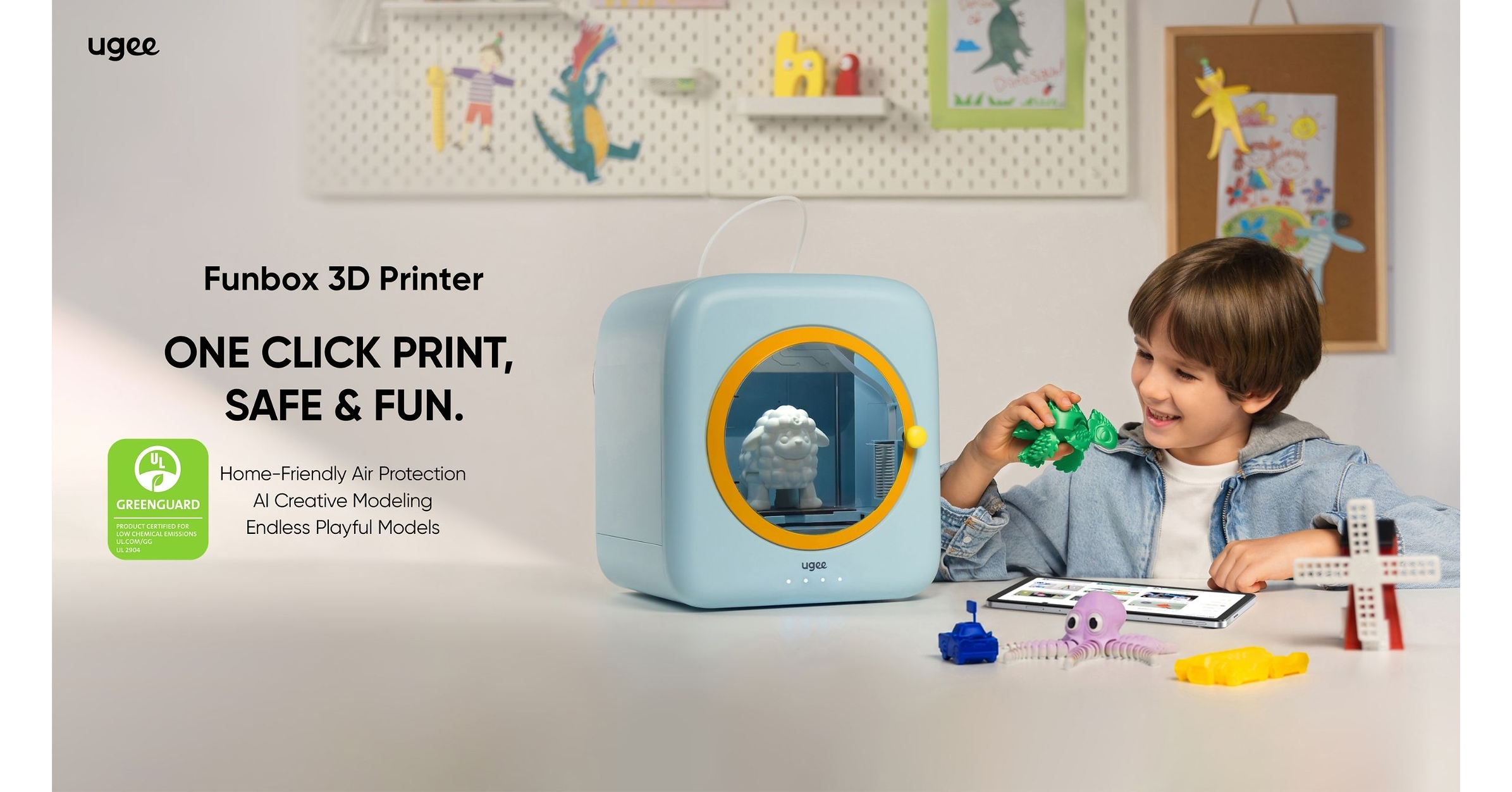
ugee lance la Funbox, sa première imprimante 3D de bureau pour enfants, à l’échelle mondiale, au prix de précommande de 269$ (7 bobines de PLA offertes aux premiers acheteurs). Le produit met en avant des fonctions de sécurité domestique certifiées (UL GREENGUARD, UL, ASTM F963-23, EN 71, EN 62115), une utilisation “une touche” sans installation, et un moteur IA ShapeGen permettant de générer des modèles 3D via description vocale/texte ou croquis. Pour les performances, la Funbox vise jusqu’à 500 mm/s, une précision de couche de 0,05 mm et une compatibilité avec les filaments PLA 1,75 mm standard, ce qui peut améliorer la proposition de valeur face à des alternatives à filaments propriétaires.
This is not a broad 3D-printing demand inflection; it is a niche attempt to repackage a low-frequency hardware category as a STEM gift product. The economic question is whether the device creates repeat usage, because the open-material model caps razor/razorblade economics and makes margins far more dependent on unit sell-through than on consumables lock-in.
Competitive pressure is mostly on private consumer brands and education-oriented toy ecosystems, not on industrial names like DDD or SSYS. If anything, the more durable beneficiary would be low-cost PLA suppliers and retail distribution channels, but that benefit is diffuse and likely too small to matter at public-market scale unless the product gets meaningful Amazon/holiday traction. The “safe at home” angle is useful marketing, yet safety certification alone does not prove willingness to pay or retention after the novelty wears off.
The main risk is that initial preorder momentum converts into weak actual utilization: returns, printer downtime, noisy operation, or parent concerns about mess/maintenance would show up quickly in reviews and kill the story within weeks. Over 1-3 months, the catalyst is independent channel checks and review velocity; over 6-18 months, the thesis only matters if the company can prove a durable family-use cohort. Absent that, any sympathy move in public 3D-printing names would likely be overdone and fade.
AI-powered research, real-time alerts, and portfolio analytics for institutional investors.
Overall Sentiment
mildly positive
Sentiment Score
0.25
