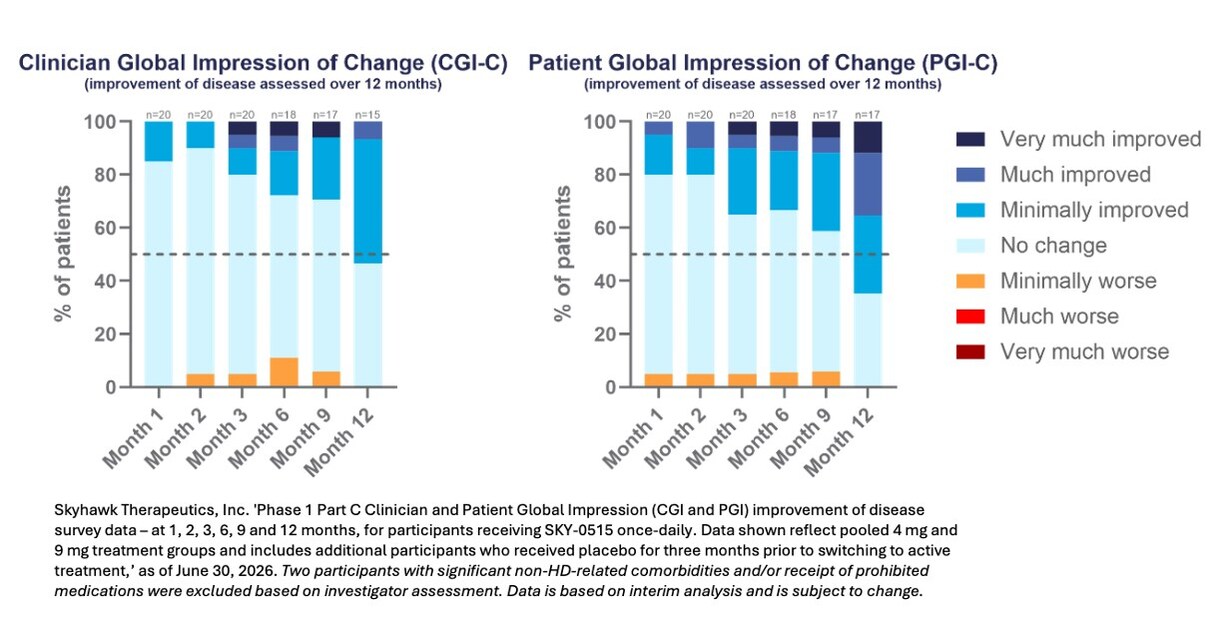
Skyhawk reported favorable twelve-month cUHDRS subcomponent trends for SKY-0515 versus expected natural-history worsening: TFC improved +0.07 vs -0.87, TMS was -2.00 vs +2.21, SDMT stabilized at -0.19 vs -1.78, and SWRT improved +3.44 vs -3.13. Clinician/participant CGI-PGI data showed no worsening at 12 months in patients expected to worsen over the period, with 65% of participants and 50% of clinicians reporting improvement. Biomarker results included dose-dependent reductions in blood mHTT up to 69% and PMS1 mRNA up to 26%, with overall CNS exposure described as strong and safety “generally safe and well tolerated.”
This is more platform-validation than commercial proof: the important signal is not the headline biomarker drop, but that a low-burden oral modality is showing a coherent biomarker-to-function bridge in a disease where prior programs have often separated the two. If that relationship holds, it expands the addressable market beyond infusion-center-dependent or gene-therapy-only strategies and compresses the perceived execution gap for small-molecule RNA modulators across other CNS rare diseases.
The first-order winners are the publicly traded HD names that can re-rate on class validation, especially programs still living or dying on the plausibility of HTT-lowering plus downstream biology: WVE and QURE are the cleanest read-throughs, though the impact is asymmetric. QURE benefits if investors conclude the bar for disease modification is lower than feared; however, it also faces higher skepticism on irreversible delivery risk if an oral option can potentially show comparable clinical directionality with much simpler dosing. Over 1-3 months, expect the market to reward any company that can claim multi-target biology or oral convenience, while punishing programs with weaker biomarker linkage or less compelling tolerability.
The main contrarian risk is that this is still an open-label, small-N signal with propensity-weighted comparisons, which can overstate effect size in slowly progressive disease. The real falsifier is the randomized FALCON-HD readout: if the placebo-adjusted cUHDRS delta narrows materially or cognitive/motor gains revert toward natural history, the stock-group read-through fades fast. For now, the more durable effect may be an increase in capital availability for RNA-splicing platforms, but that is a 6-18 month story and depends on whether the pivotal cohort reproduces the biomarker profile rather than just the narrative.
The best trade is not to chase the private company, but to express a relative-value view in public names: long a basket of platform-credible CNS RNA players versus a hedge in a single-asset HD pure-play, with timing around the next data cadence. If the market overprices class-wide success immediately, fade the move into the next two weeks and wait for the randomized dataset; if WVE/QURE gap out on incremental HD news, use strength to build a hedge against trial-risk disappointment.
AI-powered research, real-time alerts, and portfolio analytics for institutional investors.
Request DemoOverall Sentiment
strongly positive
Sentiment Score
0.55
Ticker Sentiment
