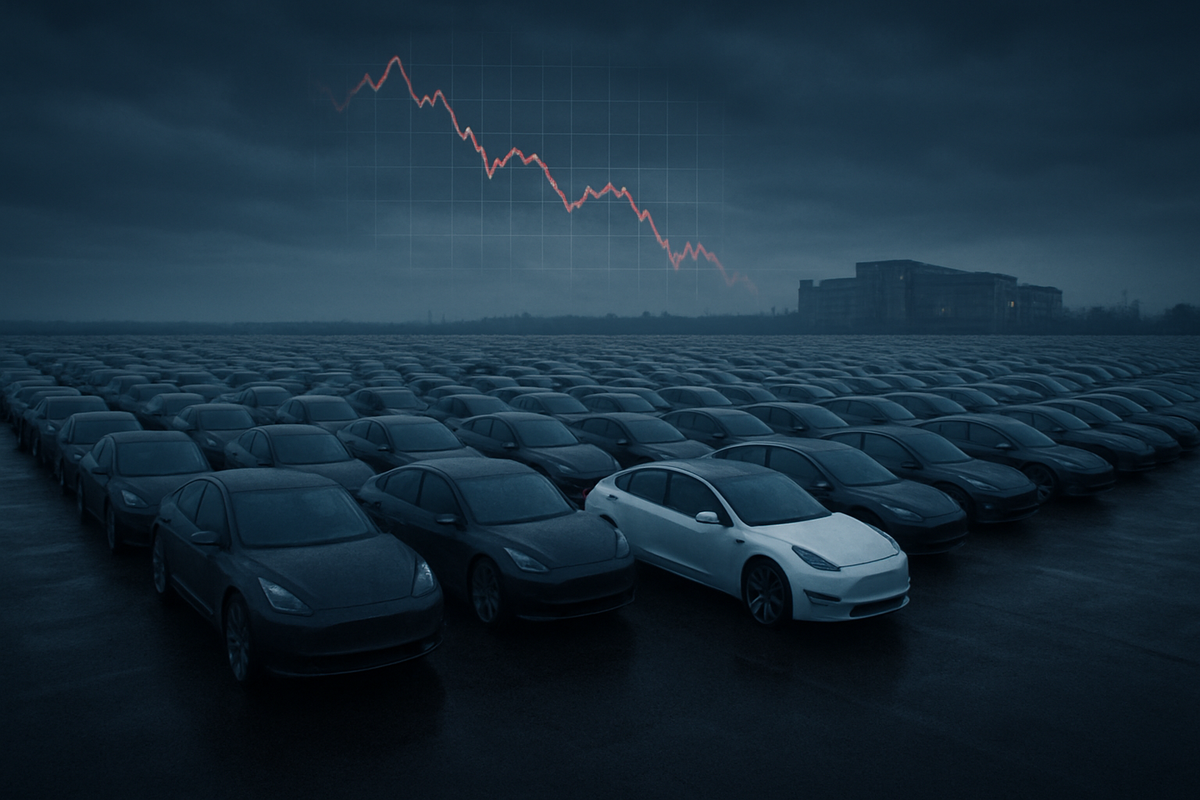
Tesla is facing a major demand and inventory shock, with Q1 2026 production of 408,386 vehicles versus deliveries of 358,023 and global unsold inventory hitting a record 164,000 units. JPMorgan’s Ryan Brinkman reiterated an Underweight rating and a $145 price target, implying about 60% downside from current levels, as Tesla’s stock has fallen for eight straight weeks and is down nearly 25% YTD. The article also points to expired $7,500 EV tax credits, weaker consumer demand, and regulatory uncertainty around the August 6 Tesla Network deadline as key near-term risks.
Tesla is moving from a scarcity-premium to an inventory-clearance story, and that matters more than the headline demand softness. When a manufacturer’s production run-rate exceeds true retail absorption for multiple quarters, the margin structure usually breaks in two stages: first through incentives and channel stuffing, then through fixed-cost deleveraging once price cuts stop working. The second-order risk is not just lower EPS, but a reset in what the market is willing to capitalize for software optionality if the core auto engine starts looking cyclical.
The competitive read-through is broader than TSLA. If Tesla is forced into aggressive discounting, the most direct beneficiaries are value-oriented EV and hybrid players with cleaner entry price points and less brand fatigue; Chinese OEMs with strong battery sourcing should also gain pricing power because they can hold MSRP while Tesla uses cash incentives. On the supplier side, the losers are likely high-beta auto semiconductor, battery materials, and logistics names tied disproportionately to Tesla volumes, while legacy OEMs with hybrid mix can quietly gain share without needing to win the pure-EV debate.
Near-term, the stock is trading like a crowded short that still has event risk around the August autonomous milestone. That creates a binary setup: weak fundamental data and inventory prints can pressure the shares for weeks, but any regulatory green light or limited commercial pilot could spark a violent squeeze because positioning is likely one-sided. The more interesting medium-term catalyst is not a full robotaxi launch; it is whether Tesla can prove a credible low-cost product strategy to arrest share loss before the market fully re-rates it as a cyclical automaker.
The consensus may be overconfident that the bear case is linear. If Tesla’s management can credibly slow production, protect gross margins via mix, and frame autonomy as a layered call option rather than a near-term profit engine, downside could be less severe than the most aggressive targets imply. Still, absent evidence of demand inflection, the burden of proof is now on bulls, and the setup favors selling rallies into event-driven spikes rather than chasing rebounds.
AI-powered research, real-time alerts, and portfolio analytics for institutional investors.
Request DemoOverall Sentiment
strongly negative
Sentiment Score
-0.78
Ticker Sentiment
