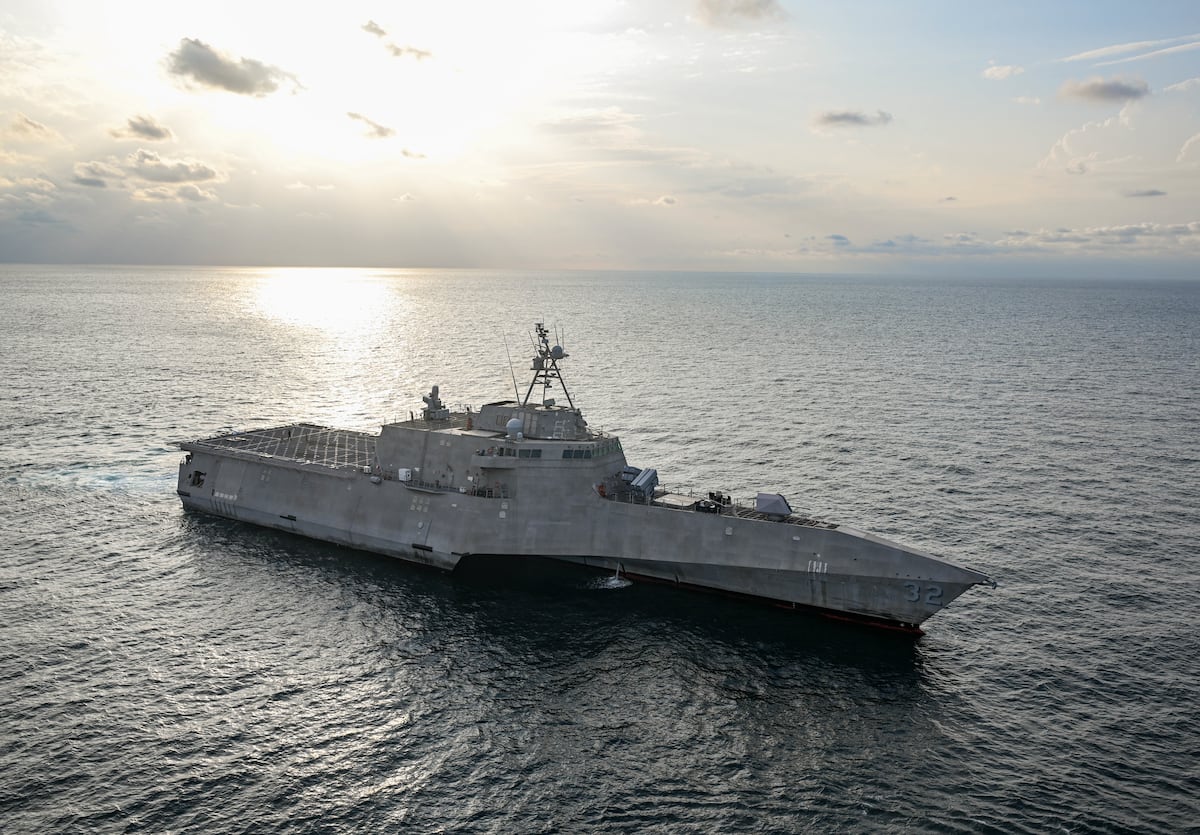
The U.S. Navy this week conducted the first-ever sea-based deployment of a one-way LUCAS attack drone from the flight deck of the Independence-class littoral combat ship USS Santa Barbara in the Arabian Gulf, executed by Task Force 59 under NAVCENT/C5F. Built by U.S. firm SpektreWorks and drawing design elements from captured Iranian Shahed drones, the launch — part of CENTCOM’s Task Force Scorpion Strike — signals accelerated fielding of low-cost autonomous strike systems to enhance regional maritime deterrence and could influence future defense procurement and operational posture in the Middle East.
Market structure: The Navy’s ship-launched LUCAS demonstration favors low-cost loitering-munition OEMs, autonomy/software suppliers, and component makers (motors, batteries, guidance). Expect revenue reallocation of ~5–15% over 12–36 months from high-end missiles toward cheap expendables; public beneficiaries include AVAV and KTOS, while legacy high-margin missile suppliers (RTX, NOC) could see slower growth in niche budgets in the near term. Pricing power shifts toward modular, scalable platforms and system integrators who control software/swarms rather than single large-platform suppliers.
Risk assessment: Tail risks include rapid regional escalation (shipping lanes disruption; oil price +10–25% if conflict widens), export-control tightening on drone components (China-sourced parts) and operational failure resulting in political backlash that pauses procurement. Immediate (days): knee-jerk defense bid rallies; short-term (weeks–months): contract awards and supply-chain stress; long-term (quarters–years): doctrinal shift to mass-produced loitering munitions. Hidden dependency: cheap drones rely on global commodity batteries and possibly Chinese components — sanctions could spike COGS by 20–40%.
Trade implications: Favor small/med-cap drone names and systems integrators: establish tactical longs in AVAV (2–3% NAV) and KTOS (1–2% NAV) using 3–9 month call spreads to limit downside; consider small longs in shipbuilders with retrofit potential (HII 1% NAV). Pair idea: long AVAV vs short small position in RTX (0.5–1% NAV) to express mean reversion if budgets shift; take profits at +25–30% and cut losses at -12–15%.
Contrarian angles: Consensus will overpay large primes initially; the market underestimates supply-chain and export-control risk that could consolidate winners to domestic manufacturers with vertically integrated supply (AeroVironment-like). Historical parallel: 2022 Switchblade adoption—small-drone stocks rerated after operational success; if LUCAS fails in combat or adversaries field cheap EW, downside is asymmetric. Key unintended consequence: accelerated proliferation prompting restrictive regulation that could compress TAM by >30% in 12–24 months.
AI-powered research, real-time alerts, and portfolio analytics for institutional investors.
Request DemoOverall Sentiment
neutral
Sentiment Score
0.12
