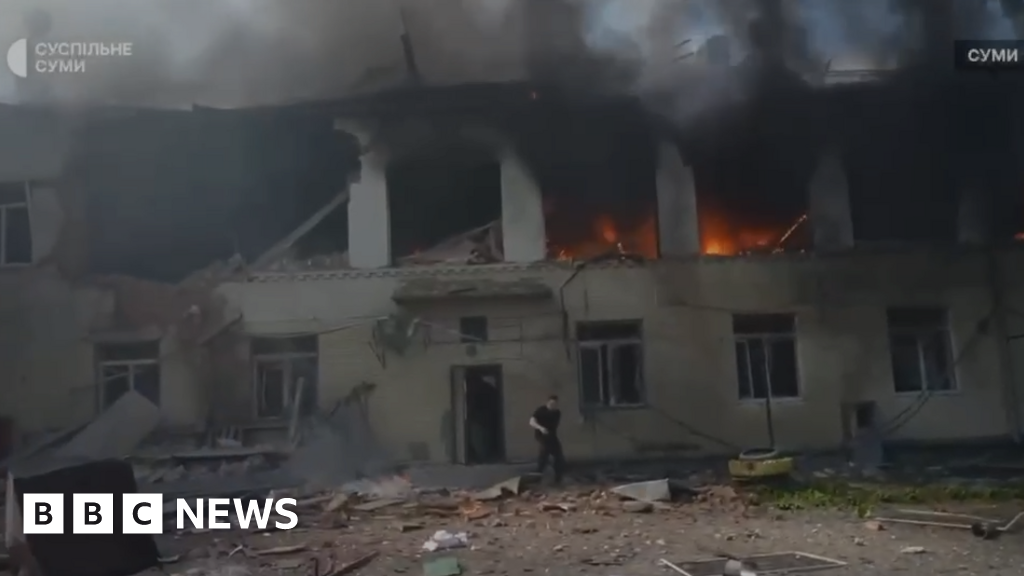
Russia launched drone and missile strikes despite Ukraine's unilateral ceasefire, with one woman killed after a kindergarten was hit in the Sumy border region and 27 people reported dead across Ukraine from Tuesday attacks, including 12 in Zaporizhzhia. Kyiv said it would respond symmetrically, while Moscow threatened a massive missile strike on central Kyiv if the truce is violated. The escalation raises geopolitical risk and could heighten volatility across European markets and defense-related assets.
This is less a ceasefire story than a signaling contest, and the market-relevant read is that both sides are optimizing for domestic optics while preserving escalation leverage. That usually increases the probability of short, violent headline-driven moves rather than a durable regime change; the next 24-72 hours matter more than the next 24-72 weeks. The key second-order effect is on air-defense consumption and replenishment rates: every drone/missile exchange burns scarce interceptors, tightening the bottleneck for Ukraine and incrementally raising urgency for Western resupply.
For defense supply chains, the near-term beneficiaries are not the headline primes alone but the layers underneath: radar, guidance, electronic warfare, and munition subcomponents. If Russian strikes intensify around symbolic dates, procurement urgency rises for systems that can be delivered quickly, which tends to favor names with existing production lines and backlogs over pure R&D stories. The other wrinkle is infrastructure resilience: repeated attacks on civilian targets keep pressure on European governments to front-load spend on shelters, grid hardening, and decentralized power, which is a slower-moving but more durable demand stream.
The main tail risk is not immediate battlefield reversal, but an escalation misread that expands strikes deeper into urban infrastructure and triggers a sharper Western policy response over 1-4 weeks. That would likely widen European risk premia, lift defense multiples, and keep energy and freight markets on alert for Black Sea or cross-border disruption. Conversely, if the weekend passes without a major retaliatory event, the premium embedded in war-sensitive assets can compress quickly, so this is a trade that should be sized for headline decay rather than conviction in a lasting de-escalation.
The contrarian view is that markets may already be conditioned to ignore symbolic ceasefire violations, which makes the immediate selloff impulse in broader risk assets overdone. But that complacency is precisely what supports owning select defense exposure on pullbacks: the asymmetry is that a single escalatory headline can re-rate the complex faster than a week of quiet can undo it. The best setup is to buy into weakness, not chase strength, because the path dependence is dominated by event risk, not fundamentals.
AI-powered research, real-time alerts, and portfolio analytics for institutional investors.
Request DemoOverall Sentiment
strongly negative
Sentiment Score
-0.78
