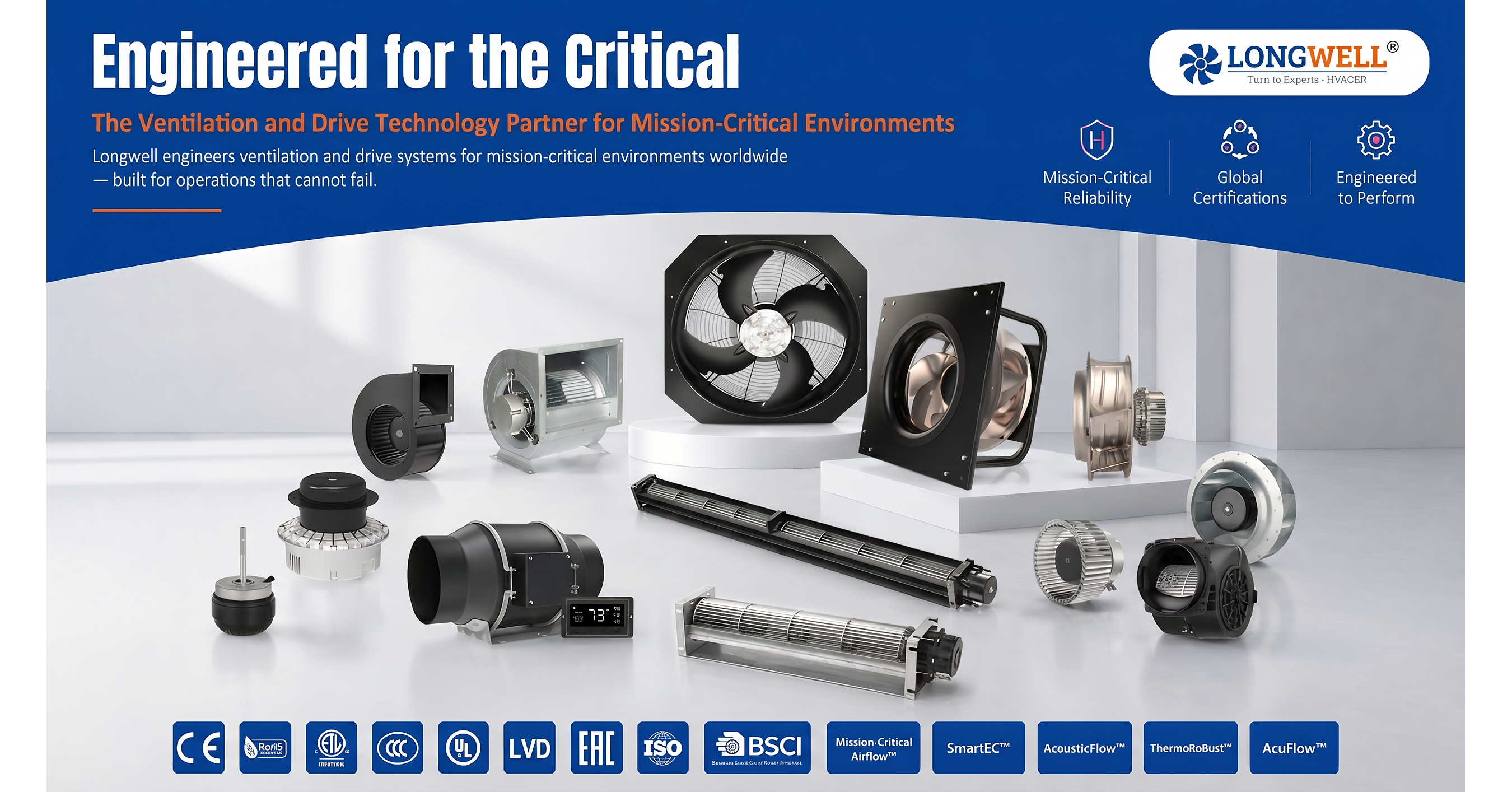
LONGWELL launched its biomimetic EC fan platform (LWBE3G) targeting 73–82% static efficiency, with 4–6 dB(A) lower noise and an 8–12% energy saving at the same airflow. It claims up to a 5–8pp efficiency improvement vs conventional designs and validated field results including ~30% energy savings on a 2024 European air-handling-unit retrofit. Delivery times are 1–3 days for samples and 15–30 days for production, vs 14–22 weeks for premium imported EC fans, supporting a faster go-to-market for HVAC and data-center airflow applications.
This is less a “better fan” story than a pricing-power test in a component category that has historically been protected by qualification friction. If a 1:1 replacement can be dropped into an existing air-handling design with shorter lead times, the economic moat shifts from engineering to procurement, which is usually bad for premium incumbent margins and good for buyers running retrofit-heavy backlogs. The first-order loser is the high-end European EC ecosystem; the second-order loser is any OEM that has been embedding that premium component cost into bids and using supply-chain scarcity to defend pricing.
The bigger market implication is on project economics, not unit demand: a single-digit reduction in HVAC/data-center cooling BOM cost can improve IRRs enough to pull forward retrofit and capacity-expansion decisions, especially where power cost is a visible line item. That should be mildly supportive for public names with exposure to cooling integration and service conversion such as VRT, TT, CARR, and JCI, but only if this technology shows up in actual field wins rather than a PR demo. In the next 1-3 months, the catalyst is channel checks or customer references; over 6-18 months, the question is whether Chinese EC vendors gain enough specification acceptance to compress industry gross margins.
Contrarian view: the market may underappreciate how slow specification cycles are in HVAC and data centers. Certifications and lab curves are necessary, but serviceability, warranty, and installed-base support usually determine whether a cheaper component becomes standard or stays a niche alternative. If there is no visible acceleration in North American/EU wins, this is probably an incremental supply-chain story rather than an equity thesis.
AI-powered research, real-time alerts, and portfolio analytics for institutional investors.
Request DemoOverall Sentiment
mildly positive
Sentiment Score
0.25
