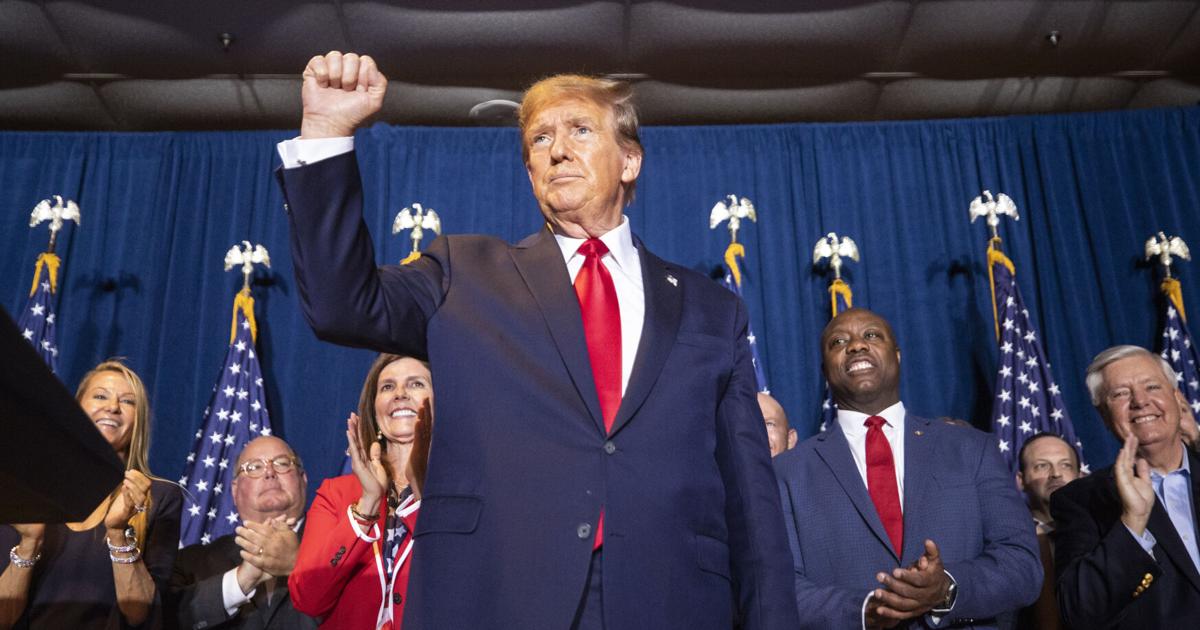
President Trump has not yet endorsed a candidate in South Carolina’s crowded Republican gubernatorial primary, leaving six contenders competing for his backing ahead of the June 9 vote. The article highlights Trump’s continued influence in GOP primaries, including his last-minute endorsement effects in Texas and South Carolina in prior cycles. This is primarily political reporting with limited direct market relevance.
The market implication is not the headline-level politics; it is the compression of decision time. In a crowded primary, a delayed presidential signal tends to increase the value of social proof rather than ideology, which favors the candidate with the broadest donor network and highest media reach over the purest base-case alignment. That usually creates a late-stage volatility spike in polling, local media spend, and adjacent consultant/media vendors rather than a linear drift in the race.
Second-order, the silence itself can be more powerful than an endorsement because it keeps multiple campaigns burning cash simultaneously. That increases runoff probability and forces candidates to preserve balance-sheet optionality, which is favorable for incumbency-style campaigns and unfavorable for low-funding insurgents. The relevant time horizon is days, not months: any Trump intervention would likely produce an immediate turnout and narrative effect, while the absence of an endorsement is only durable if it persists through election day.
The contrarian read is that the crowd may be overpricing the certainty of a late Trump endorsement as a winner-take-all catalyst. In a six-way field, endorsement efficiency is lower because vote transfers fragment, and the highest-upside outcome may actually be a non-endorsement that allows the eventual winner to claim organic legitimacy. The bigger risk is not who wins the primary, but whether a bruising contest weakens the nominee into the general and exposes fundraising fatigue among major state donors and national GOP committees.
AI-powered research, real-time alerts, and portfolio analytics for institutional investors.
Overall Sentiment
neutral
Sentiment Score
0.00
