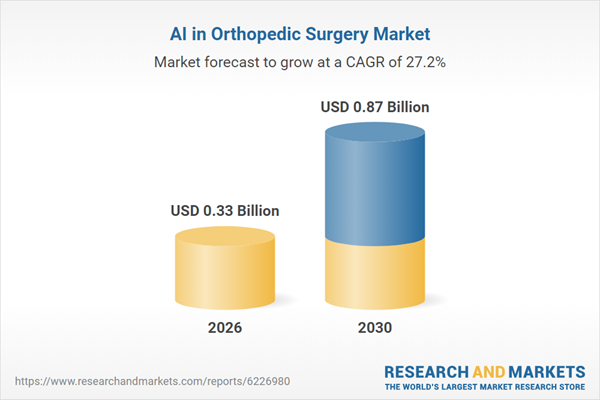
ResearchAndMarkets added an “AI in Orthopedic Surgery” report highlighting rapid market expansion from $0.26B in 2025 to $0.87B by 2030, implying a 27% CAGR. The article frames strong growth potential for AI-enabled orthopedic care solutions over the next five years.
This reads more like a category-expansion signal than an investable event. The market tends to price AI in healthcare as a software multiple story, but in orthopedics the economic moat is really distribution, installed base, and clinical evidence — so incumbents with robotic/navigation platforms are better positioned than standalone AI vendors. Over the next 1-3 months, the main effect is sentiment on medtech names tied to procedure planning and intra-op guidance; any rerating is likely modest unless paired with a clear reimbursement or regulatory milestone.
The second-order winner is the OEM that can turn AI into a consumable layer on top of hardware: Stryker (SYK), Globus Medical (GMED), Zimmer Biomet (ZBH), and to a lesser extent Smith & Nephew (SNN). If AI reduces setup time and surgeon training friction, it can accelerate procedure volumes and pull forward capital replacement cycles, but the revenue impact will show up first in higher attach rates and service mix rather than a clean standalone AI revenue line. The losers are smaller point-solution companies and legacy workflow vendors that lack their own surgical hardware funnel; they will struggle to monetize without a strategic sale.
Contrarian view: the consensus is probably overstating near-term monetization. Orthopedic adoption is constrained by operating-room throughput, evidence requirements, and hospital capex budgets, so many AI pilots will stay pilots for 6-12 months unless they prove shorter OR time or fewer revision costs. That means the trade is less about chasing the report and more about waiting for named OEM partnerships, FDA clearances, or hospital procurement data that shows AI driving measurable utilization.
Risk is that this becomes another AI healthcare narrative with limited near-term P&L translation. If reimbursement stays unchanged and surgery volumes soften, the multiple premium on medtech AI initiatives can compress quickly. What would falsify the bullish thesis is a lack of disclosed bookings/attach-rate improvement in the next two earnings cycles, or evidence that hospitals are delaying navigation/robotics upgrades despite the AI pitch.
AI-powered research, real-time alerts, and portfolio analytics for institutional investors.
Request DemoOverall Sentiment
mildly positive
Sentiment Score
0.25
