


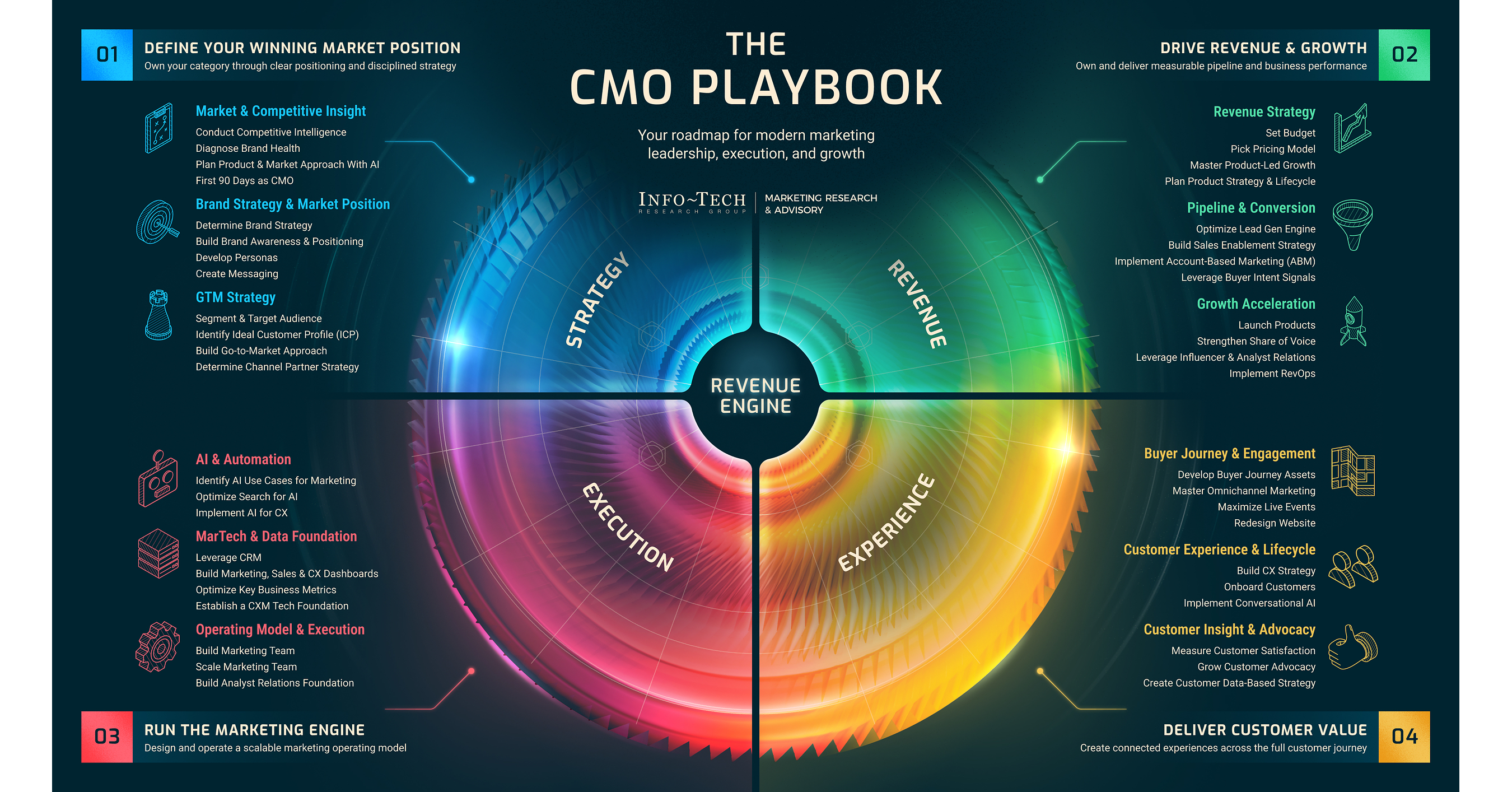
Info-Tech Research Group released its “CMO Playbook,” arguing that AI, shifting buyer expectations, and revenue accountability are reshaping the CMO role toward measurable growth. The framework highlights six key challenges (e.g., revenue attribution, fragmented attribution, AI adoption) and organizes guidance into four pillars: Strategy, Revenue, Execution (AI-enabled scalable operations), and Experience (connected customer journeys). Overall, the article is informational with no specific company results or financial impacts.
This is not a near-term revenue event for the named small-cap tickers; the more investable read is on the martech value chain. The shift in CMO priorities should favor platforms that can directly tie spend to pipeline and automate attribution workflows, while pressuring point-solution vendors and agencies that sell intent without measurable lift. In practice, that is a budget reallocation story: fewer experimental tools, more consolidation into large suites with embedded AI and analytics.
The second-order effect is margin, not just top line. If buyers demand proof of ROI, vendors with weak telemetry will see longer sales cycles, more pilots, and higher churn, while CRM/ADBE/HUBS-type incumbents can use workflow lock-in to expand wallet share. The losers are fragmented ad-tech and services businesses whose economics depend on opaque attribution and discretionary brand spend; those budgets are typically the first to be cut when CFO scrutiny rises.
Over the next 1-3 months, the catalyst is earnings commentary from software and agency names: look for evidence of budget consolidation, slower new logo conversion, or AI-driven productivity claims. Over 6-18 months, the structural winner is whoever owns the customer data layer and can quantify incrementality; the contrarian risk is that AI also lowers implementation costs for smaller vendors, letting them compete longer than expected. The thesis is falsified if enterprise marketing spend re-accelerates without stronger ROI gating, or if large suites fail to show attach-rate and retention improvement despite the AI narrative.
AI-powered research, real-time alerts, and portfolio analytics for institutional investors.
Overall Sentiment
neutral
Sentiment Score
0.05
Ticker Sentiment
