
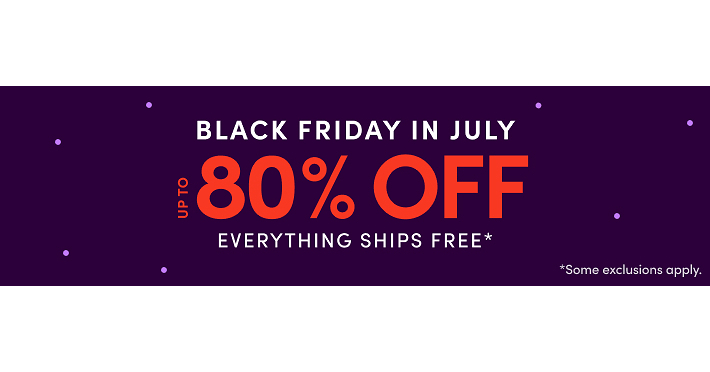
Wayfair announced a 5-day “Black Friday in July” sale July 23–27, offering holiday-level savings across its home categories, including thousands of markdowns on Wayfair Verified items. The event includes free sitewide shipping for all five days and free white-glove delivery on many items, plus 24-hour flash deals and doorbusters (e.g., Sealy 12" mattress for $369.99, Shark stick vacuum for $189.99). The news is promotional and is unlikely to materially move markets in the near term.
This reads more like demand stimulation than evidence of durable demand strength. For Wayfair, the core economic question is whether the promo lifts unit volume enough to offset the usual combination of deeper discounting, higher fulfillment subsidy, and incremental marketing spend; in home, that math often works for traffic but not for margin quality. The likely near-term market mistake would be to translate a promotional event into a revenue thesis rather than a gross-profit thesis.
The second-order effect is competitive pressure, not just on other online home sellers but on any retailer relying on discretionary home refresh spending. If Wayfair has to lean into price and free shipping to move product, that can reset customer expectations across the category and force broader promo intensity into back-to-school / fall home spending windows. The beneficiaries are parcel and last-mile networks only at the margin; the bigger economic transfer is from Wayfair’s margin to consumers, so there is limited evidence of operating leverage here.
Catalyst-wise, the relevant horizon is 1-3 months, when Q3 gross margin, take rate, and marketing efficiency will reveal whether this was incremental demand or just pull-forward. Over 6-18 months, the structural issue is that Wayfair still behaves like a high-fixed-cost retailer with weak pricing power; repeated event-driven discounting can support top-line optics while capping valuation multiple expansion. The contrarian view is that consensus may overestimate the conversion benefit of a short promo burst and underestimate the margin drag embedded in free shipping plus flash-deal mechanics.
AI-powered research, real-time alerts, and portfolio analytics for institutional investors.
Request TrialOverall Sentiment
neutral
Sentiment Score
0.05
Ticker Sentiment
