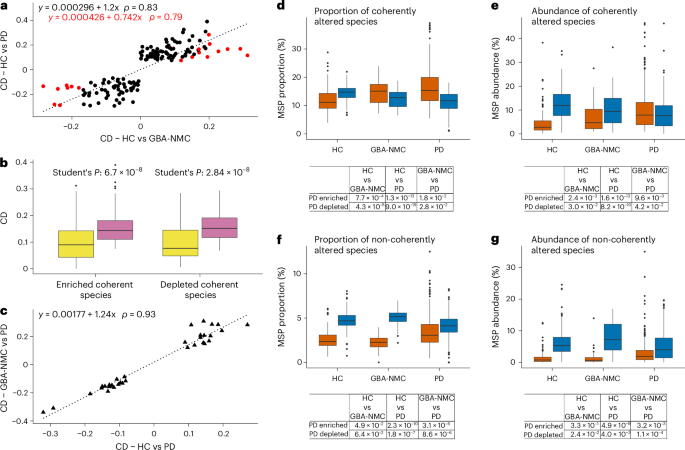
The study reports that gut microbiome changes identified a PD-like signature in 271 Parkinson’s patients, 43 non-manifesting GBA1 carriers, and 150 healthy controls, with roughly 25% of the microbiome showing coherent shifts from healthy to prodromal to overt disease. Similar patterns were validated in three external cohorts totaling 638 PD patients and 319 controls, supporting the microbiome as a potential early biomarker for premanifest PD risk. The findings are scientifically meaningful, but near-term market impact is limited because this is a cross-sectional academic study without a commercial product or regulatory event.
This is less a product story than a validation story for the biomarker platform: the investable implication is that microbiome readouts are moving one step closer to a clinically stratifiable risk layer in neurodegeneration. The near-term winners are not PD therapeutics in general but companies that can convert high-variance biological signals into regulated diagnostic workflows, longitudinal monitoring, and trial-enrichment tools. Thermo Fisher is a cleaner expression of that optionality than a broad life-science basket because it benefits from sample logistics, sequencing prep, and downstream clinical assay adoption regardless of which therapeutic modality wins.
The second-order effect is on trial design, not just screening. If microbiome signatures help enrich for faster progressors, they can compress timelines and lower sample sizes for GBA1-linked and prodromal-PD studies, which improves economics for gene-targeted and disease-modifying programs. That is a hidden positive for tools and enabling platforms, but a mixed signal for pure-play drug developers: better enrichment can make early efficacy look cleaner, yet it also raises the bar for any therapy that fails to move a biomarker linked to progression.
The contrarian risk is that this may be more correlated than causal, and the signal could be unstable across diet, antibiotics, geography, and collection protocols. That argues for treating the finding as a medium-term platform adoption catalyst rather than a near-term revenue inflection. If follow-up studies fail to show conversion prediction over 12-36 months, the market will reclassify this as an interesting association with limited commercial pull-through, especially for assay companies pitching a consumer-facing or screening use case.
AI-powered research, real-time alerts, and portfolio analytics for institutional investors.
Request DemoOverall Sentiment
mildly positive
Sentiment Score
0.20
Ticker Sentiment
