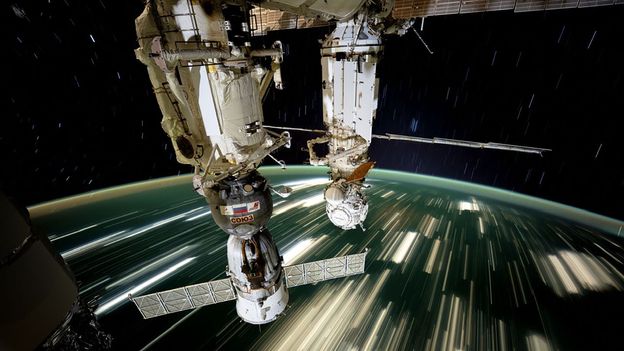
The International Space Station marks 25 years of continuous occupation, representing roughly $150bn of cumulative investment and ongoing NASA operating costs of $3–4bn per year, with contributions from Russia, North America, Europe and Japan. Key operational metrics include some 280+ visitors, 4,400 research papers, ~486,000 inventory items, 735,000 kWh/year power generation, 3,000,000 lines of code, and current commercial seat pricing around $55m (SpaceX Dragon) and ~$80m (Soyuz); notable program developments include private astronaut flights (13 individuals) and Boeing Starliner's 2024-25 docking issues that extended two crew members' stay to 286 days. For investors, the story underscores sustained government budget commitment, substantial technology and research outputs with commercial spinouts, and growing private-sector roles that are gradually lowering access costs but remain capital intensive and operationally risky.
Market structure: The ISS anniversary highlights a secular shift from government-only platforms to a mixed public/private LEO economy — winners are launch and satellite/module builders (SpaceX ecosystem, MAXR, RKLB, suppliers to LEO manufacturing) and commercial-research buyers (pharma/materials firms); losers are legacy crew-transport incumbents and OEMs with execution risk (Boeing). Lower per-seat costs (Dragon ~$55m vs Shuttle ~$1.5bn) compress pricing power for legacy integrated providers but expand addressable demand for orbital services, implying a multi-year increase in demand for payload integration and microgravity manufacturing.
Risk assessment: Tail risks include a Kessler-type debris cascade (low prob, catastrophic for LEO assets), a >10% cut to NASA human-spaceflight budgets (material to contractors), or major Boeing program failures triggering multi-quarter revenue hits; immediate risk is elevated idiosyncratic volatility in BA around Starliner updates. Time horizons: days—BA stock swings on accident/investigation headlines; weeks–months—FY appropriations, GAO/NASA reports; years—commercial LEO monetization and supply-chain localization. Hidden dependencies include Russian module availability and specialized suppliers (ammonia radiators, Cupola glazing), which could bottleneck repairs and raise insurance premiums.
Trade implications: Favor mid/small-cap space infrastructure and suppliers over legacy OEMs: allocate to MAXR and select launch plays (RKLB) with 12–36 month horizons; implement relative-value trades (long NOC or LMT vs short BA) to capture execution risk differential. Use options to express asymmetric views: buy 9–18 month LEAPS on MAXR/RKLB and a 3–6 month protective put or put-spread on BA to hedge near-term headline risk. Reweight portfolios toward Aerospace & Defense suppliers and space-tech ETFs (ARKX/XAR) while trimming cyclical commercial aviation exposure.
Contrarian angles: The market underestimates near-term revenue from microgravity pharma/materials — several private companies already converting ISS R&D into premium-priced products, implying 30–50% upside for early integrators if commercial LEO demand compounds. The negative reaction to Boeing’s Starliner program is likely overstated in the event of a successful remediation; BA is a buy-on-weakness candidate inside 12–24 months if investigation clears it. Historical parallel: post-Shuttle transition created concentrated winners (SpaceX) and long recoveries for incumbents — expect similar asymmetric outcomes here.
AI-powered research, real-time alerts, and portfolio analytics for institutional investors.
Request DemoOverall Sentiment
neutral
Sentiment Score
0.00
Ticker Sentiment
