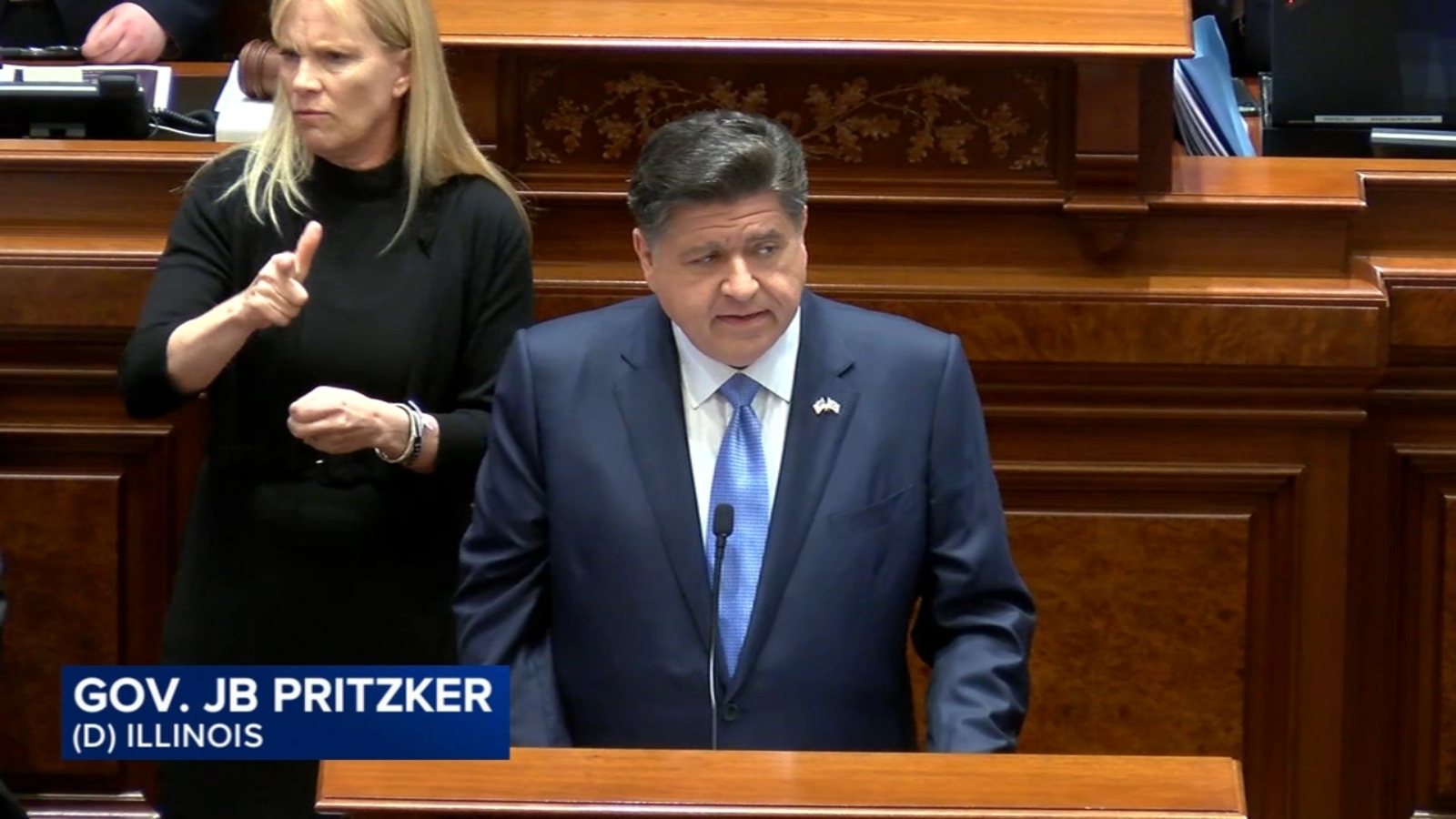
Governor Pritzker proposed a FY2027 budget totaling $56.0 billion in spending (up $878 million or 1.6%) with projected FY27 revenues of $56.1 billion (up $830 million), largely maintaining status quo and avoiding broad-based tax hikes. The plan seeks $589 million in new revenue including a novel social-media user tax aimed to raise $200 million, assumes roughly $1 billion in federal funds currently tied up in litigation will be restored, increases K‑12 Evidence‑Based Funding by $305 million, holds MAP grants flat at $721.6 million and limits higher education growth to 1%; the proposal emphasizes targeted business taxes and modest discretionary spending growth amid federal funding uncertainty.
Market structure: The budget shifts limited new spending into mandated categories (education, pensions) while raising $589M via targeted business taxes (not broad-based). The proposed social-media user tax targets $200M (≈0.36% of the $56B budget) — immaterial to FAANG revenue but meaningful as a regulatory precedent that raises compliance and per-user marginal costs for mid-sized ad platforms (SNAP, PINS, emergent platforms). Gaming tax alignment and granny-flat zoning changes create visible winners in construction, local developers, and large-scale gaming operators with Illinois exposure.
Risk assessment: Tail risks are a court loss on the $1B federal funding (could force mid-year cash draws/muni issuance) and a domino of state-level digital taxes in other states. Immediate (days) market impact is muted; short-term (weeks–months) muni spreads and Chicago-regional bank credit could widen by 20–100bp if litigation goes against Illinois; long-term (quarters–years) regulatory precedent could compress margins for digital ad monetization and raise compliance costs ~1–3% for mid-cap social platforms.
Trade implications: Tactical plays include modest long exposure to large gaming/sports-betting operators with material Illinois footprints (CZR, DKNG, MGM; 1–2% weights) and defensive hedges in big-cap social/advertisers via 3–6 month put spreads on META and SNAP (0.5–1% portfolio risk each). Short selective Chicago/regional banks (e.g., WTFC) 0.5–1% if Illinois muni 10y/Treasury premium >80bp or court rules adversely. Consider opportunistic long IL-specific munis if spreads widen >50–80bp relative to AAA Treasuries; otherwise avoid muni convexity risk.
Contrarian angles: Consensus treats the social-media tax as symbolic; mispriced is the regulatory momentum — a loss at the federal level could flip markets quickly and make state-level taxes additive, pressuring ad multiples where mid-cap platforms trade at 5–8x revenue. The market may overreact to near-term budget prudence (pricing muni risk down); a court loss would be a >sigma event for Illinois credit and create a buying opportunity in distressed IL munis 6–12 months out.
AI-powered research, real-time alerts, and portfolio analytics for institutional investors.
Request DemoOverall Sentiment
neutral
Sentiment Score
-0.05
