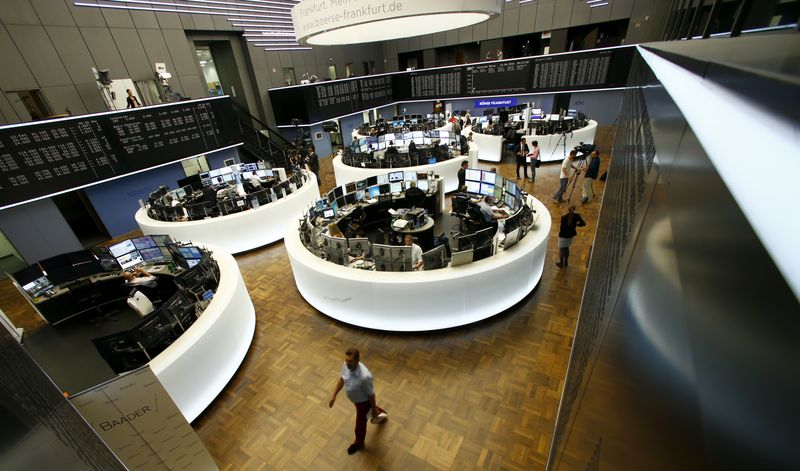
European equities were mostly flat, with the Stoxx 600 unchanged, as stalled U.S.-Iran talks kept Strait of Hormuz supply risks in focus. Nordex jumped more than 9% after first-quarter underlying earnings beat estimates, while Forvia rose over 3% after agreeing to sell its interiors business to Apollo for 1.82 billion euros. The article is primarily a geopolitics and stock-specific update rather than a broad market catalyst.
The market is still treating Hormuz risk as a headline, but the more important second-order effect is margin dispersion across the industrials complex. If crude and freight stay elevated for even a few weeks, input-cost pressure will hit European autos, chemicals, and discretionary manufacturing before it shows up in headline inflation, while energy-adjacent assets and pricing power names quietly outperform. That creates a cleaner relative-value trade than a broad macro bet: long commodity-exposed cash flows, short downstream consumers with weak pass-through.
The other underappreciated signal is the divergence between company-specific execution and sector narratives. A beat in wind and an asset sale in autos tells you investors are still willing to pay for self-help, balance-sheet repair, and visible earnings upside even in a soft tape. That favors names with near-term catalysts and low financing needs; it also argues against chasing the entire renewable complex, where equipment leaders can re-rate on prints while project developers remain hostage to rates, grid bottlenecks, and policy lag.
For the AI/compute angle, the CPU read-through matters less as a single-stock story and more as evidence that capex is broadening beyond accelerators into the full server stack. If that holds, the beneficiaries are not only chip suppliers but also memory, power, thermal, and server OEMs with better mix and pricing leverage. The risk is that investors extrapolate one beat into a multi-quarter demand cycle too quickly; if hyperscaler guidance does not confirm within 1-2 quarters, the trade will likely fade as inventories normalize.
The contrarian view is that geopolitical premium may be peaking before physical scarcity does: markets often front-run supply disruption and then give back gains once no immediate outage materializes. That makes near-dated optionality more attractive than outright cash equity if you want exposure to an escalation tail without paying for a prolonged macro shock.
AI-powered research, real-time alerts, and portfolio analytics for institutional investors.
Request DemoOverall Sentiment
neutral
Sentiment Score
0.15
