



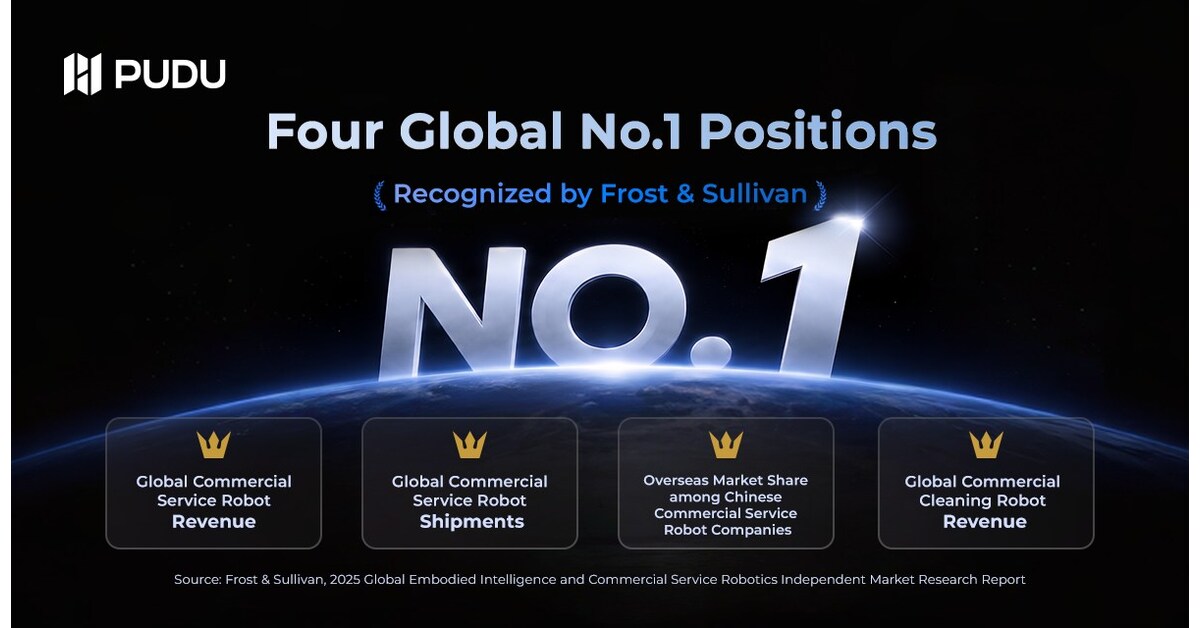
Frost & Sullivan’s 2025 report names Pudu Robotics the global No.1 commercial service robot company across four metrics, including ~25% revenue market share and ~23% shipment share. It also ranks Pudu No.1 in commercial cleaning robotics revenue (~29% share) and No.1 among Chinese peers by overseas market share (~44%), with the company reporting a 285% YoY revenue increase in the Americas. The news is a positive validation of Pudu’s growth and AI-native cleaning strategy, but it is largely recognition/market-research rather than a new financial disclosure.
This reads more as strategic validation than an immediate earnings catalyst. The market implication is not that one private robotics vendor suddenly deserves a premium, but that the commercial-service robotics category is becoming procurement-budget line item territory: airports, facilities managers, and hospitality chains are more likely to approve pilots when a clear scale leader emerges. That dynamic should support the larger ecosystem — OEM component suppliers, battery/motion-control vendors, and software integrators — while smaller point-solution competitors face margin compression as buyers standardize on a few platforms.
The less obvious loser is the labor-arbitrage model in cleaning and facility services. If autonomous cleaning adoption keeps improving in high-density, repeatable environments, the first-order impact is slower headcount growth; the second-order impact is pricing pressure on outsourced FM contracts and higher capex intensity for contractors that need to offer robotics-enabled service tiers. In public markets, that is a slower-burn headwind for labor-heavy service names rather than a near-term shock, so the tradeable effect is likely through valuation multiple pressure over 6-18 months, not a same-day move.
The key risk is that this is still a hardware economics story disguised as an AI story. Shipment leadership does not equal durable profit leadership if localization, service networks, and channel incentives eat gross margin; the market has repeatedly overpaid for unit growth in robotics before the install base became monetizable. The thesis would be falsified if follow-on filings show slowing overseas mix, weaker service revenue attach rates, or if competitive pricing forces gross margin down despite volume growth; on the macro side, tariff escalation or import restrictions could also disrupt the overseas expansion narrative within 1-3 quarters.
Contrarian view: the consensus may be underestimating how much of the upside is already in the narrative. If the company is already perceived as the scale leader, incremental "No.1" recognition may not move fundamentals unless it converts into recurring software/service revenue. The real opportunity may sit one layer down the stack in names supplying actuators, sensors, edge compute, and industrial automation infrastructure, where the share gains can persist even if end-product pricing remains competitive.
AI-powered research, real-time alerts, and portfolio analytics for institutional investors.
Request TrialOverall Sentiment
mildly positive
Sentiment Score
0.35
Ticker Sentiment
