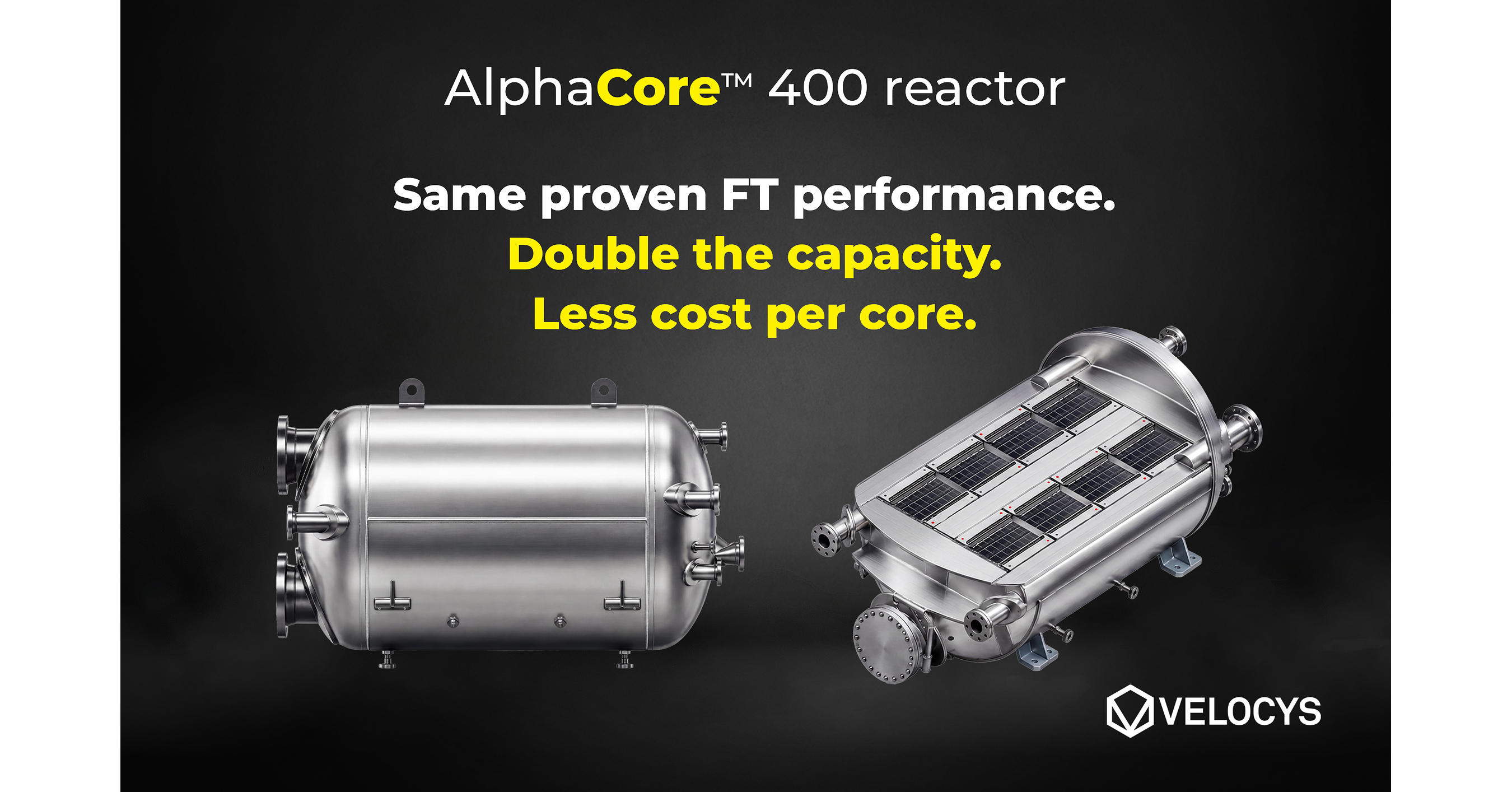
Velocys launched AlphaCore™ 400 as the first stage of a roadmap to scale microchannel Fischer-Tropsch (FT) SAF projects, claiming doubled reactor capacity versus the AlphaCore 200. The design also aims to simplify operation and lower FT unit cost by using fewer reactors and reducing material requirements/capex for higher-capacity configurations. While the update is product-focused rather than a financials-driven catalyst, it supports a more cost-competitive SAF deployment path for larger project scales.
This is directionally positive for the small subset of SAF platforms that are constrained by reactor count and plot space rather than feedstock chemistry. The important mechanism is not the press release itself; it is that lower unit capex and fewer trains can move project IRRs closer to bankable territory, which matters most for mid-sized developers trying to secure project finance before tax credit visibility fades. In practice, that favors licensors and EPCs with repeatable modular systems and disadvantages “moonshot” SAF developers whose economics only work at very large scale.
The second-order effect is competitive: if microchannel FT can credibly move up the capacity curve, it narrows the gap versus centralized hub-and-spoke plants and reduces the advantage of incumbent large-scale gasification or HEFA pathways that rely on very large balance sheets and long build cycles. That said, the market should treat this as a pipeline-expansion signal, not a revenue event. The valuation inflection will only come if Velocys can convert this into named FEED awards, offtake agreements, and FID decisions over the next 1-3 quarters.
Contrarian view: the consensus may underappreciate how much SAF economics are driven by equipment count and construction risk, but it may also be overestimating how much a single larger reactor changes the bankability equation. If larger projects still struggle on feedstock logistics, hydrogen/carbon intensity, or policy credit durability, the roadmap is just incremental engineering progress. The thesis would be falsified if the next few developer announcements still skew to pilot-scale, or if no project finance commitments appear despite the larger platform.
For public-market spillovers, the cleaner read is bullish optionality for SAF enablers and neutral-to-negative for pure-play developers that need higher capex support; the real upside would show up only if the platform becomes a template for repeat orders.
AI-powered research, real-time alerts, and portfolio analytics for institutional investors.
Request TrialOverall Sentiment
mildly positive
Sentiment Score
0.25
