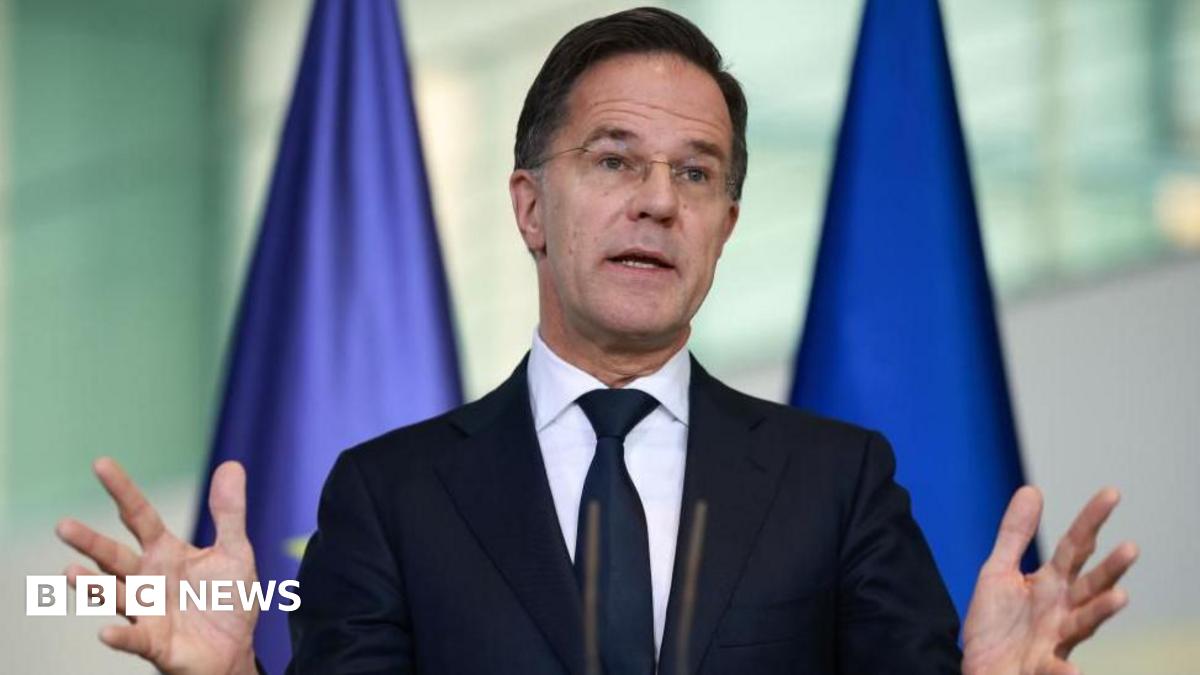
NATO secretary-general Mark Rutte credited Donald Trump with securing the alliance’s pledge at The Hague to raise defence spending to 5% of GDP by 2035, calling it Trump’s biggest foreign policy success and arguing that implementation is essential to avoid being outmatched by Russia; Rutte also warned of a possible Russian attack within five years. The piece highlights US efforts to provide Ukraine with security guarantees (including proposals modelled on Article 5 and a potential European-led multinational force) amid Russian rejection of such plans and Moscow’s continued war-footing production — roughly 150 tanks, 550 infantry fighting vehicles, 120 Lancet drones and more than 50 artillery pieces per month. For investors, the story implies sustained upward pressure on European defence budgets and procurement, an acceleration of defence industrial activity and enduring geopolitical risk premia tied to East‑West tensions.
NATO secretary-general Mark Rutte attributed the alliance's June Hague pledge to raise defence spending to 5% of GDP by 2035 to former US President Donald Trump, calling it his "biggest foreign policy success" and warning that failure to implement the commitment would leave European members "weaker than the Russians in a couple of years." Rutte also warned of a possible Russian attack within five years, framing the pledge as a response to a sustained long-term threat from Russia and terrorism.
The article documents Russia's continued wartime production surge and territorial ambitions following its 2022 invasion and annexations of parts of Ukraine; the Kiel Institute is cited as estimating monthly Russian output near 150 tanks, 550 infantry fighting vehicles, 120 Lancet drones and over 50 artillery pieces. Western Europe is described as far from comparable mass-production capacity, prompting policy responses such as France and Germany reviving voluntary military service and discussions of security guarantees and a possible European-led multinational force for Ukraine.
The combination of a formal NATO spending target, high Russian materiel output and active US-led security guarantees implies sustained upward pressure on defence budgets and multi-year procurement cycles across Europe and allied suppliers, but the investment case depends critically on implementation of national budget increases and contract awards rather than the pledge alone.
AI-powered research, real-time alerts, and portfolio analytics for institutional investors.
Request DemoOverall Sentiment
mixed
Sentiment Score
0.00
